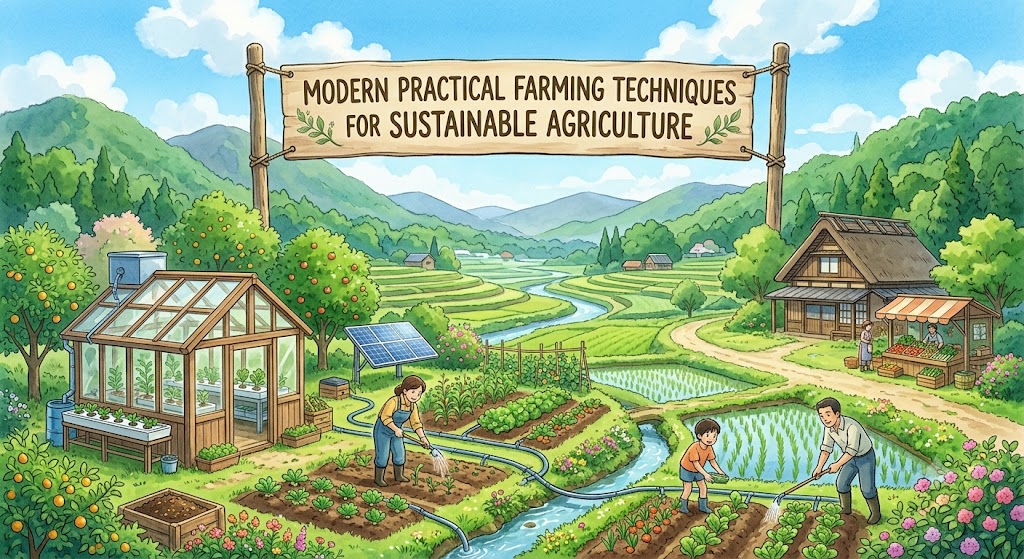
Agriculture Is Entering a New Era
Modern farming is no longer measured only by the size of a farm or the amount of fertilizer applied to a field. Today’s successful farms are built on efficiency, resource conservation, and informed decision-making. Sustainable agriculture combines traditional farming wisdom with practical innovations that improve productivity while protecting natural resources.
Farmers across the world are adopting modern techniques that reduce unnecessary expenses, improve soil fertility, conserve water, and increase crop resilience. These practices not only support higher yields but also help ensure that farmland remains productive for future generations.
Rather than depending on a single solution, sustainable farming focuses on building a balanced agricultural system where soil, water, crops, and biodiversity work together.
The Principles Behind Modern Sustainable Farming
Every successful sustainable farm is built around a few key principles:
- Protect natural resources.
- Improve soil health continuously.
- Use water efficiently.
- Reduce production waste.
- Encourage biodiversity.
- Make decisions based on field observations.
- Improve productivity without exhausting the land.
When these principles are applied consistently, farms become more resilient to climate changes and market challenges.
Technique 1: Precision Resource Management
Modern farming begins with using resources where they are actually needed instead of applying them uniformly across the entire field.
Examples include:
| Resource | Smarter Approach |
|---|---|
| Water | Irrigate according to soil moisture |
| Fertilizer | Apply based on crop growth stage |
| Labor | Prioritize high-risk field areas |
| Pest control | Treat affected zones instead of whole fields |
This targeted approach reduces waste while improving overall efficiency.
Technique 2: Regenerative Soil Practices
Healthy soil is the foundation of sustainable agriculture.
Instead of viewing soil simply as a growing medium, modern farming treats it as a living ecosystem.
Effective practices include:
- Adding organic compost
- Growing cover crops
- Reducing excessive tillage
- Returning crop residues
- Rotating crop families
Over time these practices increase microbial activity, improve soil structure, and enhance nutrient availability.
Technique 3: Climate-Smart Water Management
Water conservation has become one of agriculture’s highest priorities.
Modern farms improve irrigation efficiency by combining several practical methods:
- Mulching exposed soil
- Harvesting rainwater
- Scheduling irrigation carefully
- Improving field drainage
- Preventing water runoff
The objective is not simply to use less water but to make every litre contribute to healthy crop growth.
Technique 4: Integrated Crop Planning
Instead of selecting crops individually, sustainable farmers plan entire production cycles.
A complete crop strategy considers:
- Seasonal weather
- Soil fertility
- Previous crop history
- Expected market demand
- Pest pressure
- Harvest timing
This integrated planning improves productivity while reducing unnecessary risks.
Technique 5: Natural Ecosystem Management
Healthy farms support more than crops.
Birds, pollinating insects, earthworms, beneficial fungi, and countless microorganisms all contribute to successful agriculture.
Farmers encourage these natural partners by:
- Preserving field borders
- Growing flowering plants
- Reducing unnecessary pesticide use
- Maintaining organic matter
- Protecting natural vegetation where appropriate
A balanced ecosystem often controls many farming challenges naturally.
Technique 6: Continuous Crop Monitoring
Modern farming relies on observation rather than assumption.
Professional farmers regularly monitor:
- Plant growth
- Soil moisture
- Nutrient status
- Pest populations
- Disease symptoms
- Weather conditions
Early detection allows corrective action before problems reduce yield.
Regular monitoring is one of the most cost-effective management practices available.
Technique 7: Efficient Nutrient Management
Applying more fertilizer does not automatically produce better crops.
Modern nutrient management focuses on supplying plants with the right nutrients at the correct stage of development.
A balanced nutrition program improves:
- Root growth
- Flower development
- Fruit quality
- Disease resistance
- Harvest consistency
Balanced nutrition also minimizes nutrient losses into the environment.
Technique 8: Farm Diversification
Modern agriculture increasingly values diversified production systems.
Farmers often combine:
- Grain crops
- Vegetables
- Fruit orchards
- Livestock
- Beekeeping
- Fish farming
Diversification creates multiple income streams while reducing dependence on a single crop.
It also strengthens overall farm resilience during changing market conditions.
Practical Indicators of a Sustainable Farm
Rather than measuring success only by production volume, experienced farmers also evaluate:
✔ Soil becoming richer each season
✔ Reduced irrigation requirements
✔ Lower pest outbreaks
✔ Improved biodiversity
✔ Better crop quality
✔ Stable production costs
✔ Consistent long-term profitability
These indicators show whether a farming system is becoming healthier over time.
Common Management Decisions That Limit Sustainability
Even productive farms can lose efficiency because of avoidable practices.
Watch for these challenges:
- Repeated cultivation of the same crop
- Poor residue management
- Excessive tillage
- Over-irrigation
- Unbalanced fertilizer application
- Delayed pest monitoring
- Lack of seasonal planning
Correcting these issues often produces measurable improvements without major investment.
A Practical Roadmap for Modern Farmers
Farm improvements are most successful when introduced gradually.
Phase One
Strengthen soil health through compost and crop rotation.
Phase Two
Improve irrigation efficiency and conserve water.
Phase Three
Introduce better field monitoring and record keeping.
Phase Four
Diversify production and encourage biodiversity.
Phase Five
Review farm performance after every harvest and refine future planning.
This gradual approach keeps investment manageable while delivering long-term benefits.
Final Thoughts
Modern sustainable agriculture is not defined by expensive technology alone. It is built on thoughtful management, efficient use of resources, healthy soil, responsible water use, and continuous learning. Farmers who adopt these practical techniques create production systems that are not only profitable but also resilient to changing environmental and economic conditions.
The future of farming belongs to those who understand that sustainability is more than an environmental goal—it is a practical business strategy. Every improvement in soil health, irrigation efficiency, biodiversity, and farm planning contributes to stronger harvests, lower production costs, and greater long-term success.
Frequently Asked Questions
1. What is the main goal of sustainable farming?
The primary goal is to produce healthy crops while conserving soil, water, biodiversity, and other natural resources for future generations.
2. Are modern farming techniques suitable for small farms?
Yes. Many sustainable practices, such as crop rotation, composting, mulching, and regular field monitoring, are affordable and effective for farms of any size.
3. Why is soil health central to sustainable agriculture?
Healthy soil improves nutrient availability, water retention, root development, and natural resistance to environmental stress.
4. How does diversification benefit farmers?
Diversification reduces financial risk, creates additional income opportunities, and supports a healthier farm ecosystem.
5. Can sustainable farming improve profitability?
Yes. Efficient resource management, lower input costs, healthier crops, and better long-term productivity often result in improved farm profitability.