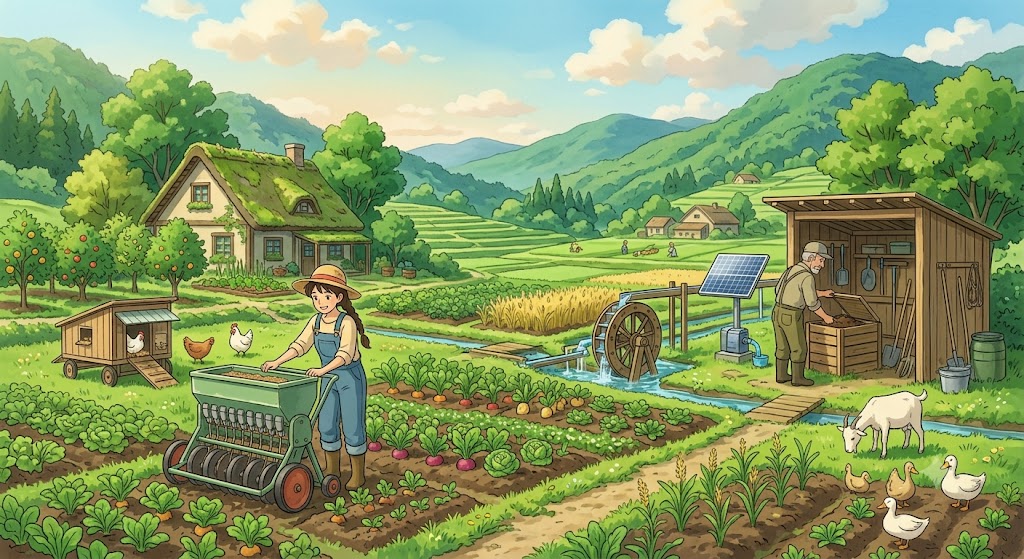
Running a farm efficiently is not only about producing a good harvest. Farmers also need to manage time, labor, water, equipment, seeds, fertilizers, transportation, and many other daily expenses. When several small inefficiencies happen at the same time, they can gradually increase the total cost of production.
The good news is that improving farm productivity does not always require expensive machinery or major investments. In many cases, better planning and simple management changes can make everyday work more organized and efficient.
A practical farming strategy begins with understanding where time and money are being spent. Once unnecessary work and avoidable expenses are identified, farmers can make targeted improvements without changing everything at once.
Think of the Farm as a Daily Workflow
Every farm has a routine.
Workers arrive, crops are inspected, animals may need attention, irrigation is managed, equipment is operated, supplies are moved, and records are updated. When these activities are poorly organized, valuable time can be lost.
A useful first step is to divide daily activities into three groups:
Essential: Tasks that directly affect crop or livestock health.
Important: Tasks that improve efficiency, maintenance, or planning.
Avoidable: Activities that consume time or resources without providing much value.
This simple classification can reveal opportunities for improvement.
For example, repeatedly traveling across a field to check the same information could potentially be reduced through better scheduling, field mapping, or simple monitoring tools.
1. Plan the Day Before Work Begins
A few minutes of planning can prevent hours of confusion later.
Before starting work, farmers can identify the most important activities for the day. Irrigation, harvesting, livestock feeding, equipment maintenance, crop inspection, and deliveries can be arranged according to priority.
Weather conditions should also be considered.
If heavy rain is expected, irrigation may not be necessary. If temperatures are expected to rise significantly, certain field activities may be more comfortable or effective during the morning.
A basic daily checklist can include:
- Priority farm activities
- Available workers
- Equipment required
- Supplies needed
- Weather conditions
- Irrigation requirements
- Harvesting or delivery schedules
The objective is simple: know what needs to be done before everyone starts working.
2. Keep Track of Where Money Goes
Many farming expenses are spread across dozens of small purchases, making them difficult to notice individually.
Seeds, fertilizer, fuel, repairs, electricity, packaging, transportation, animal feed, and labor can all contribute to production costs.
Maintaining a simple expense record can make these costs easier to understand.
Farmers can record:
What was purchased → Quantity → Cost → Purpose → Date
After several weeks or months, the information can reveal spending patterns.
For example, a farmer might discover that fuel consumption is unusually high because machinery is making unnecessary trips. Another may find that certain supplies are being purchased in small quantities at higher prices.
Good records turn assumptions into information.
3. Reduce Unnecessary Trips Around the Farm
Time and fuel can be wasted when workers repeatedly travel between fields, storage areas, workshops, and water sources.
A more organized layout can reduce this problem.
Tools used frequently should be stored in convenient locations. Supplies can be grouped according to their purpose. Equipment needed for a particular task can be prepared before workers enter the field.
Field activities can also be combined.
Instead of checking one area several times during the day, farmers can schedule inspections together when practical.
These changes may seem small, but repeated every day, they can produce meaningful savings.
4. Maintain Equipment Before It Breaks Down
Unexpected equipment failure can be expensive.
A broken pump during irrigation, a damaged tractor during planting, or a malfunctioning harvesting machine can interrupt the entire farm schedule.
Preventive maintenance helps reduce the chance of avoidable breakdowns.
Farmers can establish regular checks for:
- Tires and wheels
- Engine fluids
- Belts and moving parts
- Filters
- Irrigation pumps
- Hoses and connections
- Electrical components
- Safety equipment
Maintenance schedules should follow the manufacturer’s recommendations for specific machinery.
Spending a little time on routine maintenance can be much more manageable than dealing with a major failure during a critical farming operation.
5. Use Water According to Crop Needs
Water is both an essential agricultural resource and a potential operating expense.
Overwatering can waste water and energy while potentially creating unfavorable growing conditions. Underwatering can stress crops and reduce productivity.
Farmers can improve irrigation efficiency by checking soil moisture, understanding crop requirements, and considering recent rainfall.
Drip irrigation and other efficient systems can help deliver water closer to plant roots when appropriate.
Irrigation schedules should also be adjusted according to local weather and crop development rather than following exactly the same routine throughout the entire season.
The goal is not simply to use less water. It is to use the right amount of water at the right time.
6. Buy Inputs With a Plan
Purchasing farm supplies without a clear plan can lead to unnecessary spending.
Before buying seeds, fertilizers, animal feed, packaging, or other supplies, farmers can review current inventory and estimate upcoming requirements.
Bulk purchasing may sometimes reduce unit costs, but it is not automatically the best choice. Perishable materials, storage limitations, cash flow, and local prices should all be considered.
A cheaper product is also not necessarily better if its quality is inconsistent or if it creates additional costs later.
Smart purchasing focuses on total value rather than the lowest price alone.
7. Train Workers to Perform Tasks Consistently
Labor productivity can improve when workers clearly understand what is expected.
Simple training can cover equipment operation, crop handling, irrigation procedures, harvesting methods, storage practices, and workplace safety.
Consistency is particularly important during harvesting and post-harvest handling. Rough handling can damage produce and reduce its market value.
Farm managers can create short standard procedures for repeated activities.
For example:
Inspect → Harvest → Sort → Clean if appropriate → Pack → Store
When everyone follows a clear process, mistakes can become easier to identify and correct.
8. Reduce Post-Harvest Losses
Producing more food does not help much if a significant portion is lost after harvesting.
Post-harvest losses can occur because of poor handling, unsuitable storage temperatures, pests, moisture, damaged packaging, delays, or transportation problems.
Farmers should consider what happens to the crop immediately after it leaves the field.
Harvesting at a suitable stage, using appropriate containers, protecting produce from excessive heat, and moving products efficiently can help maintain quality.
The best approach depends on the crop. Fruits, vegetables, grains, and other agricultural products have different storage requirements.
Reducing losses can effectively increase the amount of saleable produce without increasing cultivated land.
9. Use Simple Technology Where It Actually Helps
Technology can improve farming, but farmers do not need to purchase every new device available.
Useful tools can include weather applications, digital expense records, irrigation timers, soil-moisture sensors, GPS equipment, inventory spreadsheets, and farm management software.
The important question is:
What problem will this technology solve?
If a sensor can prevent unnecessary irrigation, it may provide practical value. If a digital record can make expenses easier to track, it may save administrative time.
Technology should support the farm’s workflow rather than make it unnecessarily complicated.
10. Review Results at the End of Each Season
One of the easiest ways to improve a farm is to learn from previous results.
At the end of a growing season, farmers can compare:
- Total production
- Input costs
- Labor hours
- Water consumption
- Equipment expenses
- Crop losses
- Selling prices
- Overall revenue
This review can identify which practices worked well and which need improvement.
For example, if one irrigation method produced similar crop results while using less water, it may deserve greater use in the future.
If a particular crop generated low returns despite high input costs, the farmer may reconsider how much land should be allocated to it.
Good farming decisions become stronger when they are based on actual records.
A Simple Cost-Saving Formula
Farm efficiency can be viewed through a straightforward cycle:
Measure → Identify waste → Make one improvement → Track the result → Keep what works.
There is no need to change every part of the farm simultaneously.
A farmer could begin by reducing unnecessary trips. Once that process is working, attention can shift toward irrigation efficiency. Later, equipment maintenance, purchasing, storage, or labor organization can be improved.
Small improvements can accumulate over time.
Productivity Does Not Mean Working Harder
An important point is often overlooked: higher productivity does not simply mean asking people to work faster or longer.
True productivity means getting more useful results from the available time, labor, land, water, and equipment.
Better planning can reduce wasted movement. Preventive maintenance can reduce downtime. Accurate records can improve purchasing decisions. Efficient irrigation can reduce resource waste. Better storage can protect harvested produce.
Together, these changes can make daily farm operations more predictable.
Building a More Efficient Farm
Every farm has different conditions, so there is no universal cost-saving strategy.
The most useful approach is to identify the farm’s biggest sources of wasted time or money and address them first. Some farmers may need better irrigation management, while others may benefit more from equipment maintenance, improved storage, labor planning, or expense tracking.
The key is to make practical changes that can be measured.
A successful farm is not necessarily the one that spends the most on technology or equipment. It is often the one that manages its existing resources carefully and understands where improvements can make the biggest difference.
By planning daily activities, tracking expenses, maintaining equipment, managing water efficiently, reducing post-harvest losses, training workers, and reviewing results regularly, farmers can create a more organized operation while controlling unnecessary costs.
In the long run, efficient farming is built through many small decisions made consistently. When those decisions are supported by good records and practical experience, even modest improvements can contribute to a healthier and more productive farm business.