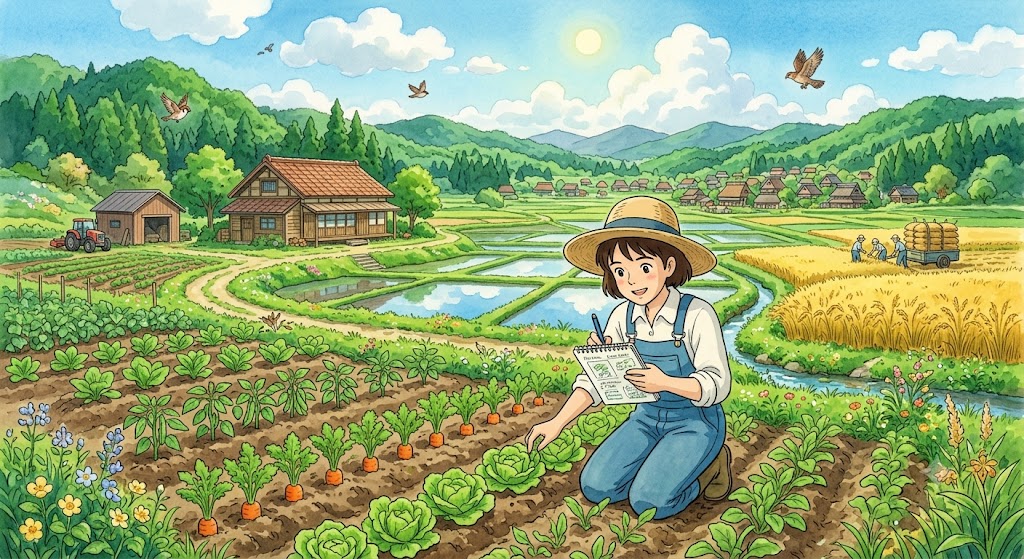
Successful crop production is rarely the result of one decision. A strong harvest usually comes from a series of small, well-timed choices made throughout the growing season. Selecting suitable seeds, preparing the soil, managing water, watching crop health, controlling weeds, and harvesting at the right time all have an impact on the final result.
Modern farming does not necessarily mean turning a farm into a fully automated operation. It means using practical knowledge, reliable information, efficient tools, and organized planning to make better decisions. Even simple technologies such as weather apps, soil testing kits, irrigation timers, digital records, and basic farm-management software can support traditional farming experience.
A simple crop-management plan can help farmers stay organized from the first day of planting until the harvested crop reaches storage or the market.
Phase One: Start With a Clear Crop Plan
Before preparing the land, decide what the farm is realistically capable of producing.
Crop selection should consider the local climate, soil conditions, water availability, growing season, labor requirements, expected market demand, and available budget.
Instead of planting based only on what performed well somewhere else, farmers should consider what is suitable for their own location.
A basic crop plan can include:
- Crop variety
- Planting date
- Expected harvest period
- Required seed quantity
- Irrigation needs
- Fertilizer requirements
- Expected labor needs
- Potential selling market
Writing these details down creates a simple roadmap for the season.
Phase Two: Prepare the Soil Before Planting
Healthy crop management begins below the surface.
Before planting, farmers should examine the condition of the soil. Soil testing can provide useful information about factors such as pH and nutrient availability. This information can help guide decisions about amendments and fertilizers.
Soil preparation should also consider drainage and compaction. Waterlogged or heavily compacted soil can create unfavorable conditions for plant roots.
Organic matter may be incorporated when appropriate to support soil structure and biological activity.
The objective is not to add as many inputs as possible. It is to create suitable conditions for the selected crop while avoiding unnecessary expenses.
Phase Three: Select Good Planting Material
Seed quality can influence the performance of an entire crop.
Farmers should purchase seeds or planting material from reliable sources and select varieties appropriate for their local growing conditions.
Important considerations may include:
Germination: Good-quality seed should have suitable germination performance.
Adaptation: The variety should be appropriate for the local climate.
Disease considerations: Varieties with useful resistance traits may be preferable where relevant.
Market preference: The final crop should match what buyers actually want.
It is also useful to keep records of the variety, supplier, planting date, and performance. These records can help farmers make better selections in future seasons.
Phase Four: Plant at the Right Time and Spacing
Timing matters in crop production.
Planting too early or too late can expose crops to unsuitable temperatures, rainfall patterns, pests, or other environmental conditions.
Local agricultural recommendations and weather information can help farmers choose an appropriate planting window.
Spacing is equally important. Plants placed too close together may compete for light, water, nutrients, and airflow. Excessive spacing, on the other hand, can leave valuable growing area unused.
The correct spacing depends on the crop variety and growing system.
A well-planned layout can make later activities such as irrigation, weed control, inspection, and harvesting easier.
Phase Five: Establish an Efficient Water Routine
After planting, consistent water management becomes one of the most important tasks.
Young plants can be sensitive to both insufficient and excessive moisture. Farmers should consider soil conditions, rainfall, temperature, crop growth stage, and irrigation-system performance.
Drip irrigation or other targeted systems can improve water delivery where appropriate.
Farmers can also inspect irrigation equipment regularly for leaks, blocked emitters, damaged pipes, or uneven water distribution.
The goal is not simply to reduce irrigation. Crops need sufficient water for healthy development. The smarter approach is to provide water according to actual crop and environmental requirements.
Phase Six: Monitor the Crop Instead of Guessing
A field should not be inspected only when something appears to be wrong.
Regular monitoring allows farmers to notice changes early.
During field walks, check:
- Leaf color and appearance
- Plant growth
- Soil moisture
- Weed pressure
- Pest activity
- Signs of disease
- Damaged plants
- Irrigation performance
Farmers can divide larger fields into sections and inspect each area systematically.
Taking photographs or maintaining a simple digital record can also make it easier to compare crop development over time.
Early detection can give farmers more options and potentially prevent small problems from becoming larger ones.
Phase Seven: Manage Weeds Strategically
Weeds compete with crops for sunlight, water, nutrients, and space.
However, weed management does not necessarily mean removing every plant immediately.
The timing and method of control should depend on the crop and the weed problem. Mechanical removal, mulching, cultivation, hand weeding, and other appropriate methods can be considered.
Keeping the area around young crops under control is particularly important because young plants may be less competitive.
Farmers should also avoid allowing weeds to produce large amounts of seed when possible, as this can make future management more difficult.
Phase Eight: Protect Crops Through Integrated Management
Pest management works best when it is treated as an ongoing process.
Farmers should identify pests before deciding what action is necessary. Beneficial insects should also be recognized because some species naturally feed on crop pests.
Crop rotation, field sanitation, suitable varieties, physical barriers, biological controls, and targeted treatments can all form part of an integrated approach.
Not every insect requires immediate treatment.
The practical goal is to protect crop health while avoiding unnecessary interventions. When a treatment is required, farmers should follow appropriate product instructions and local agricultural guidance.
Phase Nine: Feed the Crop Based on Its Needs
Plants require nutrients throughout their development, but their requirements can change as they grow.
Instead of applying fertilizer according to a fixed routine without checking conditions, farmers can use soil-test information, crop growth observations, and local recommendations to guide nutrient management.
Overapplication can increase costs and may create environmental problems.
Underapplication can limit crop growth.
A balanced nutrient plan considers the crop, soil, expected yield, previous crops, and available organic or mineral nutrient sources.
Keeping records of fertilizer applications can also help identify which practices produce useful results.
Phase Ten: Use Simple Technology to Improve Decisions
Modern farming tools can support traditional knowledge without replacing it.
Weather applications can help farmers monitor upcoming conditions. Soil-moisture sensors can provide information about irrigation needs. GPS tools can help with field mapping, while digital spreadsheets can simplify expense and production records.
Farmers do not need to adopt every available technology.
A better strategy is to identify a specific problem first.
For example:
Problem: Too much time is spent checking irrigation.
Possible solution: Use scheduled irrigation or monitoring tools.
Problem: Farm expenses are difficult to track.
Possible solution: Maintain a simple digital expense record.
Problem: Certain parts of the field consistently perform poorly.
Possible solution: Map those areas and investigate soil, water, drainage, or pest differences.
Technology becomes useful when it solves a real problem.
Phase Eleven: Prepare for Harvest Before It Arrives
Harvest planning should begin before the crop reaches maturity.
Farmers need to consider labor, containers, transportation, storage, equipment, and market arrangements.
Waiting until the last moment can create unnecessary pressure.
Harvest timing also matters. Different crops have different maturity indicators, and the ideal stage may depend on whether the product is being sold locally, transported over a long distance, or stored for later use.
Workers should understand how to handle the crop carefully to reduce unnecessary physical damage.
Good harvesting practices protect the value of the work completed throughout the entire growing season.
Phase Twelve: Protect Quality After Harvest
Crop management does not end when the product leaves the field.
Fresh produce can lose quality quickly if it is exposed to unsuitable temperatures, moisture, pests, rough handling, or long delays.
Farmers should therefore establish a simple post-harvest process:
Harvest → Sort → Handle Carefully → Store Appropriately → Transport → Sell
The exact process depends on the crop.
Damaged or unsuitable produce should be separated where appropriate, while saleable products should be protected from conditions that could reduce their quality.
Reducing post-harvest losses can effectively increase the amount of production that reaches consumers.
Keep Records for the Next Season
One of the most valuable modern farming tools is also one of the simplest: good records.
At the end of the season, farmers can review:
- Seed costs
- Fertilizer costs
- Water use
- Labor requirements
- Pest problems
- Harvest quantity
- Crop losses
- Selling prices
- Overall profitability
This information helps turn one growing season into knowledge for the next.
If a particular variety performed well, it may deserve another trial. If one field required unusually high input costs, farmers can investigate why. If harvesting was delayed because of a labor shortage, next season’s planning can begin earlier.
A Farming Plan That Gets Better Every Season
Modern crop management does not need to be complicated.
A practical system can follow a simple cycle:
Plan → Prepare → Plant → Monitor → Adjust → Harvest → Review
The important part is the adjustment stage. Farming conditions can change throughout the season, so farmers should be willing to modify irrigation, crop protection, nutrient management, labor planning, or harvesting schedules when reliable information indicates that a change is needed.
The strongest farming systems are not necessarily the most expensive. They are the ones that combine agricultural experience with careful observation and sensible resource management.
From Seed to Harvest, Every Decision Counts
Better crop management is built through hundreds of small decisions rather than one major action. Selecting suitable planting material, preparing healthy soil, managing water carefully, monitoring crops regularly, controlling weeds, protecting plants, planning harvests, and reducing post-harvest losses can all contribute to a more efficient operation.
Modern farming simply gives farmers more ways to make those decisions using information.
Whether a farm is small or large, the basic principle remains the same: understand the conditions, plan ahead, monitor regularly, and learn from the results.
When these habits become part of the normal farming routine, crop management becomes more organized and predictable. Over time, that can help farmers use their available land, labor, water, and inputs more effectively while building a stronger foundation for future growing seasons.