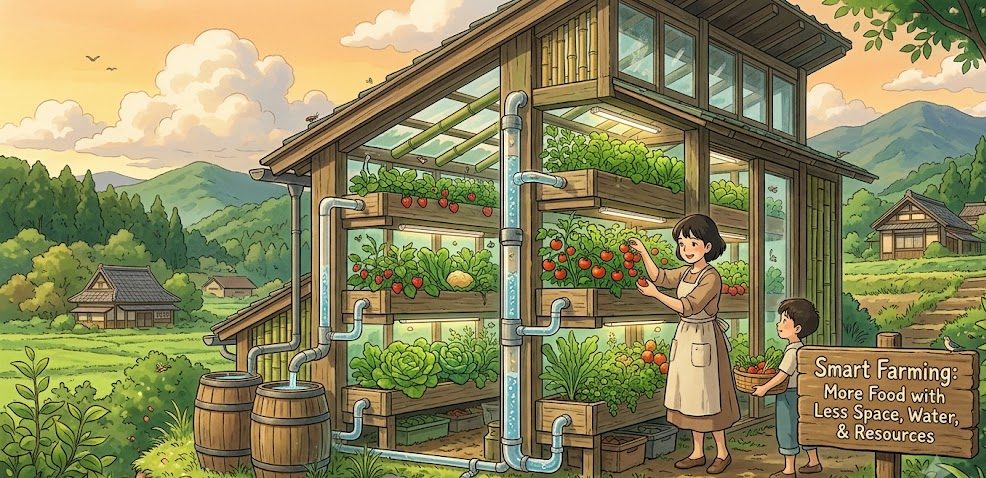
Agriculture is changing quickly as farmers look for better ways to produce food without putting unnecessary pressure on land, water, and other resources. With growing populations, changing weather patterns, rising input costs, and limited farmland in many areas, improving farm efficiency has become increasingly important.
Smart farming focuses on making better decisions rather than simply using more resources. It combines practical agricultural methods, careful planning, modern tools, and efficient growing systems to help farmers get more value from the resources they already have.
The good news is that smart farming does not always require expensive equipment or highly advanced technology. Techniques such as drip irrigation, vertical growing, soil monitoring, crop rotation, protected cultivation, and precise fertilizer application can make farms more productive while reducing waste.
The New Goal: More Production With Better Resource Management
For a long time, increasing agricultural production often meant cultivating more land or using more water and fertilizers. Smart farming takes a different approach.
Instead of asking, “How can we use more resources?” farmers can ask, “How can we use each resource more effectively?”
This shift can make a significant difference. A well-designed irrigation system can deliver water directly to plant roots instead of wetting unnecessary areas. Soil testing can help determine which nutrients are actually needed. Crop planning can reduce empty spaces and improve the use of available farmland.
Smart farming is therefore less about one particular machine and more about using information, planning, and efficient techniques together.
1. Vertical Farming for Limited Land
When farmland is expensive or unavailable, growing upward can be an effective solution.
Vertical farming involves growing plants in stacked layers rather than using only a single horizontal surface. Depending on the system, crops can be grown indoors, in greenhouses, or in specially designed structures.
Leafy vegetables, herbs, microgreens, and some other crops are particularly suitable for these systems.
The major advantage is space efficiency. Multiple growing levels can produce food from a relatively small footprint. Controlled environments can also make it easier to manage factors such as temperature, lighting, and irrigation.
However, vertical farming can require considerable investment in infrastructure and electricity, especially for indoor operations. It is therefore important to evaluate energy costs and crop value before adopting the system.
2. Drip Irrigation to Reduce Water Waste
Water is one of the most important resources in agriculture, making efficient irrigation a major part of smart farming.
Drip irrigation delivers water slowly and directly near the roots of plants. Instead of distributing large quantities of water across an entire field, the system can provide moisture where it is most useful.
This can reduce unnecessary evaporation and runoff, particularly when the system is properly designed and maintained.
Farmers can make the system even more efficient by combining irrigation schedules with information about soil moisture and weather conditions. For example, irrigation may not be necessary immediately after significant rainfall.
Regular inspection is also important because blocked emitters, leaks, or damaged pipes can reduce system performance.
3. Soil Monitoring for Smarter Decisions
Healthy soil is the foundation of productive agriculture. Yet farmers cannot always determine what is happening below the surface simply by looking at a field.
Soil testing and monitoring can provide useful information about moisture, pH, organic matter, and nutrient levels.
This information allows farmers to make more informed decisions about irrigation and fertilization. Instead of applying the same amount of fertilizer everywhere, nutrient applications can be adjusted according to crop requirements and soil conditions.
Simple soil tests can already provide valuable information, while digital sensors can offer more frequent monitoring for farms that can justify the additional investment.
The objective is not to collect technology for its own sake. The objective is to use reliable information to avoid unnecessary inputs and support healthier crop growth.
4. Hydroponics: Growing Without Traditional Soil
Hydroponics is another method that can help produce crops in areas where traditional soil-based agriculture is difficult.
In a hydroponic system, plants receive water and nutrients through a carefully managed growing solution rather than obtaining nutrients directly from field soil.
Because water can be collected, monitored, and circulated in many hydroponic systems, the method can potentially use water more efficiently than some conventional growing approaches.
Hydroponics is commonly used for crops such as lettuce, herbs, and other vegetables.
However, successful hydroponic production requires careful management. Nutrient concentration, water quality, temperature, sanitation, and equipment all need attention. A technical system can also become expensive if it is poorly planned.
For this reason, farmers should understand the crop, system requirements, and operating costs before making a major investment.
5. Precision Farming: Giving Each Area What It Needs
A field may look uniform from a distance, but soil conditions and crop performance can vary significantly from one section to another.
Precision farming uses information and technology to identify these differences.
GPS equipment, field maps, sensors, satellite imagery, drones, and farm management software can help farmers understand variations in crop growth, moisture, and soil conditions.
Instead of treating an entire field exactly the same, farmers can potentially apply water, nutrients, or other inputs more precisely.
For large farms, this can improve resource management and reduce unnecessary applications. Smaller farms can also adopt the same principle without expensive equipment by dividing fields into sections and monitoring them separately.
The important factor is making decisions based on actual field conditions rather than assumptions.
6. Protected Cultivation for Better Use of Space
Greenhouses, shade houses, tunnels, and other protected structures allow farmers to create a more controlled growing environment.
These systems can protect crops from certain weather conditions, pests, and environmental stresses while helping farmers manage temperature, humidity, and irrigation.
Protected cultivation can also extend growing seasons for selected crops.
The structure does not automatically guarantee higher production, however. Ventilation, temperature management, sanitation, crop selection, and irrigation still need to be handled properly.
Farmers should choose a protected system based on their climate, available budget, target crop, and local market demand.
7. Crop Rotation and Intercropping
Smart farming is not limited to technology. Traditional agricultural knowledge can also play an important role.
Crop rotation involves growing different crops in sequence rather than repeatedly planting the same crop in the same location. Different crops have different nutrient requirements and growth characteristics, which can help support better soil management.
Intercropping takes another approach by growing two or more compatible crops together.
For example, a taller crop may be combined with a shorter crop that uses available space beneath or between plants. When planned correctly, this can help farmers make better use of sunlight, soil, and available land.
The success of intercropping depends heavily on crop combinations, spacing, timing, and local growing conditions.
8. Smart Fertilizer Management
Fertilizers can play an important role in crop production, but applying more fertilizer does not necessarily mean producing more food.
Excessive or poorly timed fertilizer applications can waste money and may contribute to environmental problems.
A smarter approach starts with understanding the soil and crop requirements. Soil testing can help identify nutrient deficiencies, while crop growth stages can guide the timing of applications.
Farmers can also consider organic matter, compost, manure, and other soil-improvement practices where appropriate.
Good fertilizer management aims to provide plants with the nutrients they need without unnecessary application.
9. Using Farm Technology for Better Monitoring
Modern farmers have access to tools that can make monitoring easier.
Mobile applications, weather stations, sensors, automated irrigation controllers, GPS systems, and farm management platforms can help collect and organize information.
A farmer might use weather information to plan irrigation, monitor field conditions through a mobile device, or receive an alert when soil moisture drops below a chosen level.
Technology can save time, but it should support practical farm decisions rather than replace agricultural knowledge completely. Data is useful only when it is accurate and interpreted correctly.
A Simple Smart Farming Framework
Farmers who want to improve efficiency do not have to transform their entire operation overnight.
A practical approach can look like this:
Start with the biggest problem → Measure it → Choose a suitable solution → Test on a small area → Compare results → Expand if it works.
For example, if water consumption is the biggest concern, improving irrigation may be a better first step than purchasing expensive automation equipment.
If land is limited, vertical growing or protected cultivation might deserve more attention.
If fertilizer costs are high, soil testing and nutrient management could provide a more practical starting point.
Choosing the Right Method for the Farm
There is no single smart farming method that works perfectly for every farm.
Climate, soil type, crop selection, farm size, labor availability, electricity access, water availability, market prices, and investment capacity all influence which approach makes sense.
A small vegetable grower may benefit from drip irrigation and raised beds, while a large commercial farm might gain more from GPS-guided equipment and precision application systems.
The best system is not necessarily the most technologically advanced one. It is the system that solves a real problem and provides measurable value.
The Future of Resource-Efficient Agriculture
Smart farming is likely to become increasingly important as agriculture faces pressure to produce food efficiently while managing limited resources responsibly.
The future will probably involve a combination of traditional farming knowledge and modern technology. Sensors may help farmers understand field conditions, automated systems may improve irrigation, and data tools may support better crop planning. At the same time, basic practices such as maintaining healthy soil, selecting suitable crops, and managing water carefully will remain essential.
Smart farming is ultimately about efficiency. By using land more intelligently, applying water and nutrients more carefully, and monitoring crops more effectively, farmers can work toward stronger production without depending on unlimited resources.
The most successful farms will not necessarily be those with the most technology. They will be the ones that understand their resources, identify their biggest challenges, and choose practical solutions that make sense for their specific conditions.