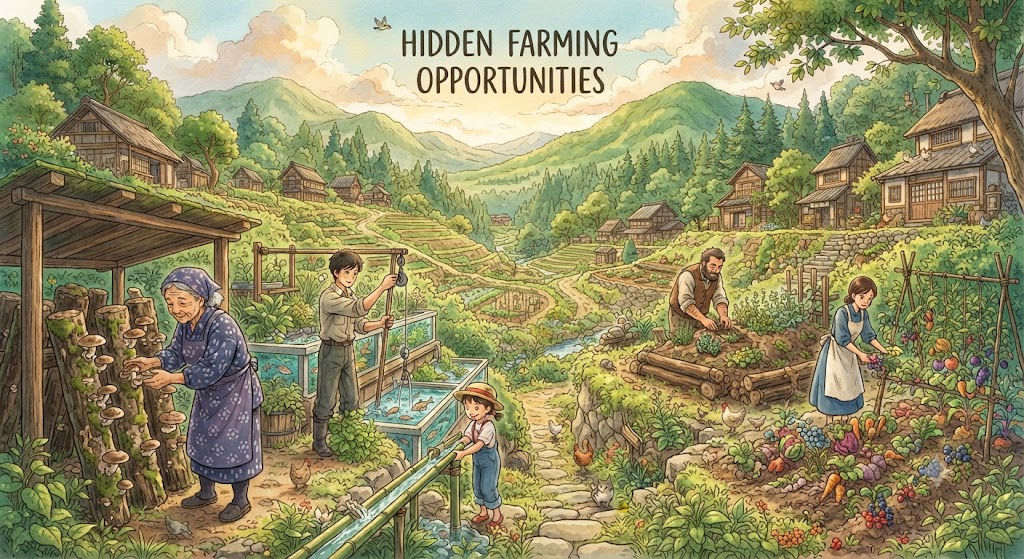
Agriculture is often associated with familiar crops such as wheat, rice, corn, vegetables, fruits, and livestock. However, modern farming is much broader than these traditional categories. Changes in consumer preferences, local food markets, technology, climate conditions, and demand for specialty products have created opportunities in areas that many new farmers may not immediately consider.
These less-known agricultural ideas can be particularly interesting for small and medium-sized growers. Some require very little land, while others can be combined with an existing farm. Certain methods focus on specialty crops, controlled environments, unusual livestock systems, or value-added products rather than simply producing large quantities of traditional crops.
The important point is that a lesser-known farming opportunity is not automatically a profitable one. Every idea still requires research, suitable growing conditions, reliable buyers, proper management, and realistic financial planning. The goal is to identify opportunities that match the resources and market available in a particular location.
Specialty Herb Farming
Herbs are often overlooked when people think about commercial agriculture. While common culinary herbs are widely available, specialty varieties can create opportunities for growers who can supply restaurants, food businesses, local markets, and specialty retailers.
Examples include culinary herbs, aromatic herbs, drying herbs, and plants used for teas or natural food products. Some herbs can also be grown in containers, raised beds, or protected structures, making them suitable for smaller operations.
The main advantage of specialty herb production is that the crop does not necessarily require a huge field. A farmer can potentially produce a larger range of products from a relatively limited area.
However, harvesting and post-harvest handling are important. Fresh herbs can lose quality quickly, so growers need a reliable way to clean, package, store, and deliver them.
Microgreens as a Small-Space Opportunity
Microgreens are young edible plants harvested shortly after germination. They have become increasingly popular among restaurants, food businesses, home cooks, and consumers interested in fresh ingredients.
One interesting feature of microgreens is their space efficiency. They can be grown on trays using shelves or other organized systems, which means production does not always require traditional farmland.
Different varieties can provide different colors, flavors, textures, and growing times. This allows growers to experiment with several products rather than depending on one crop.
The challenge is that microgreens are highly perishable. A grower needs consistent production and a dependable customer base. Restaurants may also expect predictable quality and delivery schedules.
For this reason, microgreens are better approached as a small production business rather than simply planting trays and hoping customers appear.
Edible Flower Farming
Edible flowers represent another specialized agricultural niche. Certain flowers can be used to decorate desserts, salads, drinks, and restaurant dishes.
The market is smaller than the market for conventional vegetables, but specialty products can attract customers who are willing to pay for quality, appearance, freshness, and consistency.
Edible flower farming requires careful attention to plant selection and production practices. Flowers intended for food should be grown specifically for edible use and should not be treated with products that are unsuitable for consumption.
Packaging is also important because delicate flowers can easily become damaged during harvesting and transportation.
Mushroom Production
Mushroom cultivation can be an interesting alternative for growers who do not have large amounts of farmland. Many mushroom production systems take place indoors or in controlled environments.
Unlike field crops, mushrooms do not depend on large areas of open soil. Production can potentially take place in a dedicated room, shed, or other suitable structure when environmental conditions can be managed properly.
Oyster mushrooms are one example that has attracted attention among small-scale growers because they can be cultivated using suitable agricultural or plant-based growing materials.
The business side is particularly important. Mushrooms have a limited shelf life, so production should be connected to a realistic sales channel. Local restaurants, markets, wholesalers, and direct customers can all represent potential outlets depending on the region.
Seedling and Nursery Farming
Some agricultural businesses make money by supplying plants rather than harvesting mature crops.
A nursery can produce vegetable seedlings, fruit plants, ornamental plants, herbs, native plants, or other varieties suited to local demand. This model can be attractive because growers purchase young plants when they want to save time or improve establishment.
A well-managed nursery requires attention to seed quality, growing media, watering, disease prevention, labeling, and timing.
The timing of production can be particularly important. A nursery needs to have the right plants ready when local farmers and gardeners are preparing their fields.
Native and Drought-Tolerant Plant Production
Changing weather patterns and water availability have increased interest in plants that can perform under relatively demanding conditions.
Growing native plants, drought-tolerant landscape species, and regionally adapted plants can create opportunities beyond traditional food production.
These plants may be purchased by homeowners, landscapers, municipalities, ecological restoration projects, garden centers, and other organizations.
This type of farming requires strong knowledge of local plant species and environmental conditions. The opportunity can be especially interesting in regions where water conservation is an important concern.
Aquaponic Farming
Aquaponics combines fish production with plant cultivation in a connected system. Fish provide nutrients through their waste, while plants help filter the water as part of the system.
The concept allows farmers to produce two types of agricultural output within one integrated operation.
Aquaponics can be attractive where land or water resources are limited, but it is more technically demanding than simply growing plants in soil. Water quality, fish health, temperature, filtration, plant nutrition, and system balance all require regular monitoring.
It should therefore be treated as a managed production system rather than a simple shortcut to farming with less land.
Vertical Farming for Small Spaces
Vertical farming uses stacked growing areas to make better use of limited indoor space.
This method can be particularly useful for crops with relatively short growing cycles and compact root systems. Leafy greens and herbs are commonly associated with controlled-environment production.
The biggest attraction is the ability to produce multiple growing layers within a small footprint.
However, electricity, lighting, climate control, equipment, and maintenance can make vertical farming expensive. A successful operation therefore needs careful calculations of production costs, expected selling prices, energy use, and customer demand.
Vertical farming makes the most sense when the economics of the specific crop and location support the investment.
Bamboo Farming
Bamboo is another agricultural opportunity that is sometimes overlooked. Depending on the species and local regulations, bamboo can be used for construction materials, furniture, crafts, landscaping, food products, and other applications.
Unlike annual crops, bamboo is a long-term planting that requires planning before commercial production begins.
The farmer should investigate suitable species, climate requirements, harvesting practices, local buyers, transportation costs, and the time required before meaningful production is available.
Bamboo should therefore be viewed as a long-term agricultural investment rather than a quick-income crop.
Fodder Production
Livestock farmers constantly need dependable sources of animal feed. This creates opportunities for specialized fodder production.
Farmers can produce green fodder, forage crops, hay, silage, or other feed materials depending on local livestock systems and climate.
The advantage is that the customer base can be relatively clear when livestock farms are located nearby.
A producer should understand the nutritional requirements of the animals being served and maintain consistent quality. Storage is also important because some types of fodder are seasonal.
Beekeeping as a Farm Integration Opportunity
Beekeeping can be integrated with crop production rather than treated as a completely separate agricultural business.
Honey is the most familiar product, but beeswax and other hive-related products can also have commercial uses.
Pollination can also be an important part of agricultural ecosystems, particularly where flowering crops depend on insect pollinators.
Beekeeping requires specialized knowledge because colonies are living systems that need regular management. Weather, forage availability, pests, diseases, and seasonal changes can influence colony health and production.
Farmers considering beekeeping should learn proper colony management and local regulations before investing in equipment and colonies.
Vermicomposting and Organic Soil Products
Agricultural businesses do not always need to sell food directly to consumers. Soil-related products can also create opportunities.
Vermicomposting uses earthworms to process suitable organic material into a nutrient-rich soil amendment. Farmers, gardeners, nurseries, and landscaping businesses may purchase compost and related products.
The model can work particularly well when organic materials are available locally and can be processed efficiently.
Quality control is important because customers need a consistent product. The business should also follow applicable local rules regarding waste handling and agricultural products.
Seed Saving and Specialty Seeds
Seed production is another less-visible part of agriculture. Farmers and gardeners require reliable planting material every growing season.
Specialty seed businesses may focus on regional varieties, unusual vegetables, heritage-type varieties, flowers, herbs, or crops adapted to particular growing conditions.
Seed production requires careful crop isolation, harvesting, drying, storage, labeling, and quality management. It can also involve regulatory requirements depending on the crop and location.
For small growers, a carefully selected specialty seed market may be more realistic than competing directly with large commercial seed companies.
Agroforestry
Agroforestry combines trees with crops, livestock, or other agricultural activities.
Instead of treating farmland as a completely open field, farmers can design systems where trees provide useful functions such as shade, wind protection, habitat, timber, fruit, nuts, or other products.
The approach requires long-term planning because trees take time to establish. Spacing, root competition, sunlight, water availability, machinery access, and harvesting schedules all need consideration.
Agroforestry can be especially interesting for farmers who want to diversify production rather than depend entirely on one annual crop.
Controlled-Environment Farming
Greenhouses, shade structures, tunnels, and other protected growing systems allow farmers to control some environmental conditions.
This can extend growing seasons, protect plants from certain weather conditions, and improve consistency for selected crops.
Protected cultivation is not automatically cheaper or easier than outdoor farming. Construction, irrigation, ventilation, temperature management, and maintenance all add costs.
The strongest opportunity often comes from using controlled environments for crops that have a clear market advantage when grown under protection.
Value-Added Farming
Sometimes the hidden opportunity is not a different crop but a different way of selling the crop.
A farmer who produces tomatoes, fruits, herbs, grains, or other products may be able to create additional value through processing, packaging, drying, preservation, or direct-to-consumer sales where permitted.
For example, dried herbs can have a longer shelf life than fresh herbs. Properly processed fruits can become different products. Grain can potentially be sold in cleaned, packaged, or otherwise prepared forms.
Value-added agriculture requires additional equipment, food-safety considerations, packaging, labeling, and potentially licensing. The regulations vary depending on the product and location.
How to Choose a Less-Known Farming Opportunity
The biggest mistake is choosing an unusual farming idea simply because it sounds profitable.
A better approach is to evaluate the opportunity from several practical angles.
First, study the local market. Find out who would actually buy the product and how frequently they purchase it.
Second, calculate production costs before making a large investment. Include seeds, equipment, water, electricity, labor, packaging, transportation, maintenance, and expected losses.
Third, examine the climate and available resources. A crop that performs well in one region may struggle in another.
Fourth, consider how quickly the business can generate revenue. Microgreens and seedlings may have relatively short production cycles, while trees and perennial crops can require years of planning.
Finally, begin with a manageable test. A small pilot can reveal production difficulties and customer reactions before a farmer commits significant capital.
Building a Diversified Farm
One of the most interesting opportunities in modern agriculture is combining several complementary activities.
A farm could potentially combine traditional crops with seedlings, compost production, beekeeping, specialty herbs, livestock, or direct sales.
Diversification does not mean adding every possible activity. Too many unrelated operations can increase complexity and reduce efficiency.
The better approach is to choose activities that share resources, customers, infrastructure, labor, or seasonal timing.
For example, a farm producing vegetables might also operate a seedling nursery because the same growing knowledge and customer relationships can support both activities.
Final Thoughts
Hidden agricultural opportunities are often found outside the most obvious crops and farming models. Specialty herbs, microgreens, mushrooms, nurseries, aquaponics, bamboo, fodder, beekeeping, seed production, agroforestry, and value-added products all demonstrate how agriculture can extend beyond traditional field farming.
The most suitable opportunity depends on the farmer’s land, climate, skills, budget, infrastructure, and local market.
Successful agricultural businesses usually begin with a simple question: Who will buy this product, and why?
Once that question has a realistic answer, the next step is to test production on a manageable scale, measure actual costs, learn from the results, and expand only when the business model makes sense.
Less-known farming does not have to mean risky farming. With careful research, controlled experimentation, and a clear understanding of the local market, unconventional agricultural ideas can become practical additions to a diversified farm.