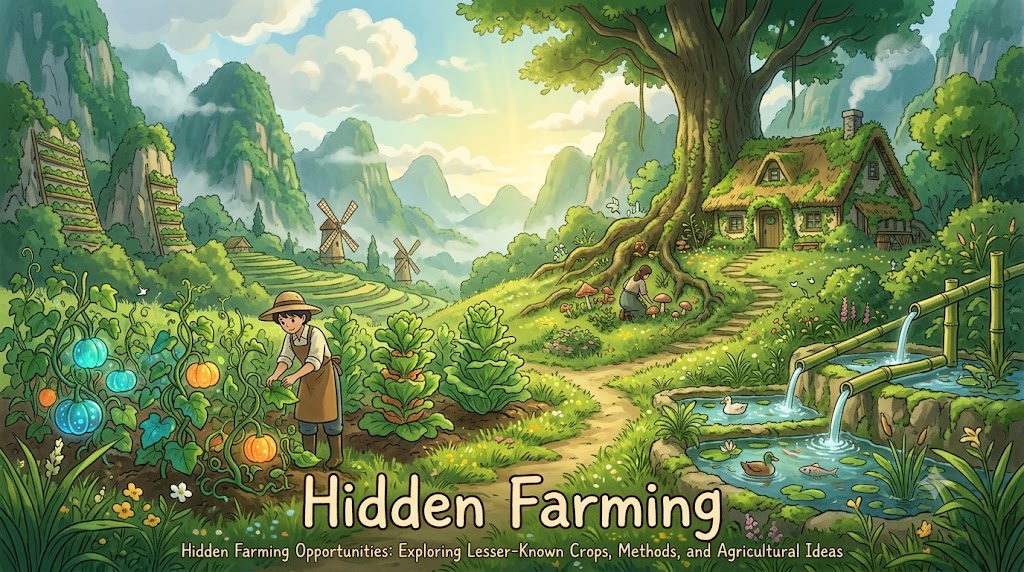
Farming is often associated with familiar crops such as wheat, rice, corn, vegetables, fruits, and common livestock. These traditional agricultural activities remain important, but they are not the only opportunities available to modern farmers. Across different regions, there are lesser-known crops, specialized growing methods, unusual farm products, and small-scale agricultural ideas that can create new possibilities.
This concept can be described as hidden farming—not because the activities are secret, but because they are often overlooked when people think about agriculture.
Hidden farming opportunities can range from growing specialty herbs and traditional crops to producing planting material, raising useful insects, cultivating mushrooms, experimenting with controlled environments, or combining multiple agricultural activities on the same property. Some opportunities may require very little land, while others can be integrated into an existing farm.
The most important principle is simple: a crop or farming idea should not be selected only because it appears profitable. Climate, water availability, soil conditions, labor, infrastructure, storage, local demand, transportation, and access to buyers all influence whether an idea is practical.
This guide explores the concept of hidden farming and explains how farmers can identify lesser-known opportunities while building a sensible agricultural plan.
1. What Is Hidden Farming?
Hidden farming refers to agricultural opportunities that receive less attention than mainstream farming activities.
These opportunities may involve:
- Lesser-known crops
- Traditional or forgotten varieties
- Specialty vegetables
- Herbs and aromatic plants
- Mushroom cultivation
- Nursery and planting-material production
- Controlled-environment farming
- Small livestock systems
- Beekeeping and pollination-related activities
- Farm-based processing
- Agricultural by-products
- Specialized organic growing systems
The idea is not necessarily to replace conventional farming. Instead, hidden farming can provide another layer of diversification.
For example, a farmer may continue growing a major seasonal crop while using a smaller area for a specialty crop. Another farmer may use unused space for seedlings, mushrooms, herbs, or protected cultivation.
This approach can make agriculture more flexible because income does not depend entirely on one crop.
2. Why Lesser-Known Farming Ideas Matter
Agriculture is changing because consumer preferences, food businesses, technology, and supply chains are changing.
Large-scale commodity crops generally compete in established markets. Specialty agricultural products can operate differently because they may serve smaller but more specific customer groups.
A lesser-known crop might be useful to a particular food company, restaurant, processor, herbal-product business, seed producer, or local market.
However, limited competition does not automatically mean easy profits.
A specialty crop can have a small market, higher production requirements, limited buyers, or difficult transportation. That is why research should come before large investment.
The real opportunity often comes from finding a good match between production capability and market demand.
3. Explore Forgotten and Traditional Crops
One of the most interesting areas of hidden farming is the cultivation of traditional crops that are no longer widely grown.
Many regions have agricultural varieties that were once common but gradually disappeared as farmers shifted toward commercially popular crops.
These traditional crops may have unique characteristics such as distinctive flavors, unusual colors, different growing seasons, or cultural importance.
Farmers can investigate local agricultural history and identify varieties that once performed well in their region.
Before planting at commercial scale, it is useful to test a small area and evaluate:
Growth: Does the crop perform well under local conditions?
Labor: How much manual work does it require?
Harvest: Is harvesting simple or highly specialized?
Storage: Can the product remain usable after harvest?
Market: Are there realistic buyers?
Repeat demand: Would customers purchase it regularly?
A forgotten crop becomes a useful farming opportunity only when production and demand can be connected.
4. Specialty Vegetables Can Create Smaller Markets
Mainstream vegetables are highly competitive, but specialty vegetables can serve more specific markets.
Examples may include unusual varieties of tomatoes, colorful carrots, specialty peppers, miniature vegetables, heritage vegetables, edible flowers, and uncommon leafy greens.
Restaurants, specialty food stores, farmers’ markets, and direct consumers may be interested in products that look different or offer unique culinary uses.
The challenge is consistency.
Specialty buyers may expect uniform size, appearance, freshness, packaging, and reliable delivery. Therefore, a farmer interested in specialty vegetables should think about quality control as carefully as crop production.
A small trial can reveal whether the local market is genuinely interested before significant resources are committed.
5. Herb and Aromatic Plant Farming
Herbs can be another interesting category because some varieties require relatively small growing areas.
Depending on the climate and market, farmers may explore culinary herbs, aromatic plants, traditional-use plants, and plants used in food processing.
The business model can also extend beyond fresh produce.
Instead of selling everything immediately after harvest, a farmer may explore cleaning, drying, grading, packaging, or supplying processed raw material to appropriate buyers.
However, processing requirements and regulations should be understood before starting a commercial operation.
The strongest opportunity may come from producing a consistent product rather than simply growing a plant that appears unusual.
6. Mushroom Cultivation: Farming Without Traditional Fields
Mushroom cultivation demonstrates how agriculture can move beyond conventional open-field farming.
Many mushroom production systems can operate in controlled spaces rather than traditional farmland. This makes the concept interesting for people with limited land.
The growing environment must be managed carefully. Temperature, humidity, cleanliness, air movement, growing medium, and contamination control can strongly influence results.
Mushroom farming also requires a reliable production schedule because fresh mushrooms are generally more time-sensitive than durable crops.
A small controlled setup can be used to learn the production process before expanding.
The key lesson is that agricultural production does not always require large fields.
7. Nursery Farming: Selling Plants Instead of Harvest
Another overlooked agricultural opportunity is plant propagation.
Instead of growing crops until harvest, a nursery business focuses on producing seedlings, saplings, transplants, ornamental plants, fruit plants, vegetable seedlings, or other planting materials.
This model can serve farmers, gardeners, landscapers, homeowners, and agricultural businesses.
Nursery production requires attention to plant health, propagation techniques, containers, growing media, watering, labeling, and customer demand.
Timing is particularly important. A nursery must often have planting material available when customers are ready to establish their crops.
This creates an interesting business model because the farmer is essentially selling the beginning of another farmer’s production cycle.
8. Micro Farming for Small Spaces
Not every agricultural opportunity requires a large farm.
Micro farming focuses on producing useful quantities from limited areas through careful planning and efficient use of space.
Raised beds, containers, vertical structures, compact growing systems, and intensive planting layouts can make small areas more productive.
A small-space operation might specialize in seedlings, herbs, salad greens, specialty vegetables, or other crops suited to frequent harvesting.
The advantage is that starting costs and operational complexity can sometimes be easier to control.
The disadvantage is that small production areas require excellent organization. Every square meter needs to serve a purpose.
9. Vertical and Controlled-Environment Farming
Controlled farming methods allow growers to manage parts of the growing environment rather than relying entirely on outdoor conditions.
Depending on the system, growers may control lighting, irrigation, temperature, humidity, nutrients, or airflow.
Vertical farming takes this concept further by using multiple growing levels.
These systems can be useful where land is limited, but they also introduce equipment, electricity, maintenance, and technical requirements.
Therefore, controlled farming should not be viewed simply as a high-tech shortcut.
A practical approach is to begin with one manageable system, understand operating costs, monitor production, and expand only when the economics make sense.
10. Seed Production Can Be a Specialized Opportunity
Seeds are the starting point of crop production, yet seed-related farming is often overlooked by people entering agriculture.
Small-scale seed production can involve suitable vegetable varieties, traditional crops, flowers, herbs, or other plants depending on local regulations and market requirements.
Producing quality seed requires careful selection, isolation where necessary, proper harvesting, drying, cleaning, storage, and labeling.
Seed businesses also require strong attention to quality and compliance.
For farmers with experience in plant production, seed-related activities can become an additional specialization rather than a completely separate business.
11. Beekeeping as a Farm Companion
Beekeeping can complement crop farming because bees play an important role in pollination.
A farm with flowering crops, orchards, or suitable surrounding vegetation may provide opportunities for beekeeping.
The activity requires specialized knowledge of hive management, seasonal conditions, colony health, equipment, and safe handling.
The important idea is diversification.
Instead of thinking about the farm only as a place where crops grow, farmers can consider how different agricultural activities interact.
Crops can provide resources for bees, while managed pollinators can support suitable agricultural systems.
12. Insect-Based Agricultural Opportunities
Some insects have agricultural value beyond pollination.
Certain insect species can be used in specialized food, feed, composting, or research-related systems, depending on local regulations and market demand.
Insect farming can require relatively controlled spaces, but it is not automatically simple.
Temperature, humidity, feed, hygiene, handling, and legal requirements must all be considered.
This is an example of why hidden farming should be approached as a research exercise rather than a trend-following exercise.
A unique idea is valuable only when it can be produced safely and sold through a legitimate market.
13. Farm Waste Can Become a Resource
One of the most overlooked opportunities on farms is the value of agricultural by-products.
Crop residues, manure, damaged produce, husks, stems, leaves, and other materials can sometimes be reused through composting, mulching, soil improvement, animal-feed systems where appropriate, or other agricultural processes.
The goal is not to assume that every waste material has commercial value.
Instead, farmers can examine where resources are being lost and determine whether they can be reused productively.
Better resource utilization can reduce unnecessary waste and potentially lower input requirements.
14. Combine Multiple Activities Instead of Depending on One Crop
A diversified farm can contain several connected activities.
For example, one operation could combine:
Field crops → seasonal vegetables → seedlings → composting → small livestock → direct sales
The exact combination depends on land, climate, labor, and market access.
The benefit of diversification is that different activities may operate at different times of the year.
However, too much diversification can also create management problems.
A farm should not become a collection of unrelated experiments. Each activity should have a clear purpose.
15. Look for Agricultural Gaps in Your Local Area
The best hidden opportunity may not be a rare crop.
It may simply be something customers cannot easily find locally.
Farmers can observe local markets and ask practical questions:
What products are regularly transported from far away?
Which crops are frequently unavailable?
Which products have inconsistent quality?
Which planting materials are difficult to find?
What do restaurants or food businesses repeatedly purchase?
Which agricultural services are missing?
These questions can reveal opportunities that are more realistic than copying a farming trend from another region.
16. Test Before Scaling
One of the most important principles in hidden farming is to experiment on a small scale first.
A farmer can divide a small area into trial sections and compare different varieties, planting times, irrigation methods, or growing techniques.
During the trial, record:
Input cost
Labor requirement
Water consumption
Growth performance
Harvest quantity
Product quality
Selling price
Customer response
Unexpected problems
These records make it easier to determine whether an idea deserves expansion.
A successful small experiment does not guarantee a successful large farm, but it provides much better information than making a large investment without testing.
17. Think About the Buyer Before Planting
One of the biggest mistakes in specialty agriculture is producing first and searching for customers later.
A better sequence is:
Identify the product → identify potential buyers → understand specifications → estimate production cost → test demand → grow a small quantity → collect feedback → expand carefully
This approach helps farmers understand what customers actually want.
A buyer may care about size, color, packaging, delivery schedule, minimum quantity, freshness, or processing quality.
Understanding these requirements before production can prevent avoidable losses.
18. Technology Can Reveal Hidden Opportunities
Technology can help farmers make better decisions.
Simple digital tools can be used to track expenses, crop schedules, irrigation activities, inventory, sales, weather observations, and harvest results.
More advanced systems may use sensors, automated irrigation, satellite imagery, farm-management software, or data analysis.
The goal should not be to use technology simply because it is modern.
Technology is useful when it solves a real problem.
For example, automated irrigation may be valuable where water management is difficult, while detailed software may be unnecessary for a very small operation with simple records.
19. A Simple Hidden Farming Opportunity Framework
Before starting any unusual agricultural project, evaluate it through five questions.
Land
Does the idea fit the available space and soil conditions?
Resources
Is there enough water, labor, equipment, electricity, and infrastructure?
Market
Who will purchase the product?
Economics
Can expected revenue reasonably cover production, labor, transportation, and other costs?
Risk
What happens if prices fall, weather changes, pests appear, or the expected buyer disappears?
An opportunity that performs reasonably well across these five areas deserves further investigation.
20. Build a Farming Portfolio
The future of farming does not necessarily have to be based on one crop.
A small agricultural portfolio might include a dependable seasonal crop, a specialty crop, a nursery activity, a value-added product, and a resource-recycling activity.
The combination should remain manageable.
The purpose of diversification is not to make the farm complicated. It is to create multiple paths for productivity and reduce dependence on one agricultural activity.
Final Thoughts
Hidden farming opportunities exist in many forms. They can be found in forgotten crops, specialty vegetables, herbs, mushrooms, nurseries, controlled growing systems, beekeeping, agricultural by-products, small-space production, and farm diversification.
But the most important lesson is that unusual does not automatically mean profitable.
A successful agricultural idea must fit the environment, resources, skills, and market available to the farmer.
The smartest approach is to observe local demand, research unfamiliar opportunities, start with a controlled experiment, maintain accurate records, and expand only after the numbers and practical results make sense.
Farming becomes more interesting when we stop looking only at the most common crops and start asking better questions.
What is missing from the local market?
What resources are currently being wasted?
What can be produced on unused space?
Which traditional crops deserve another look?
Which agricultural activities can work together?
These questions can uncover opportunities that are easy to miss.
Hidden farming is ultimately less about finding a secret crop and more about seeing agriculture from a different angle. With careful planning, experimentation, and market awareness, even a small agricultural idea can become a useful part of a broader and more resilient farming system.