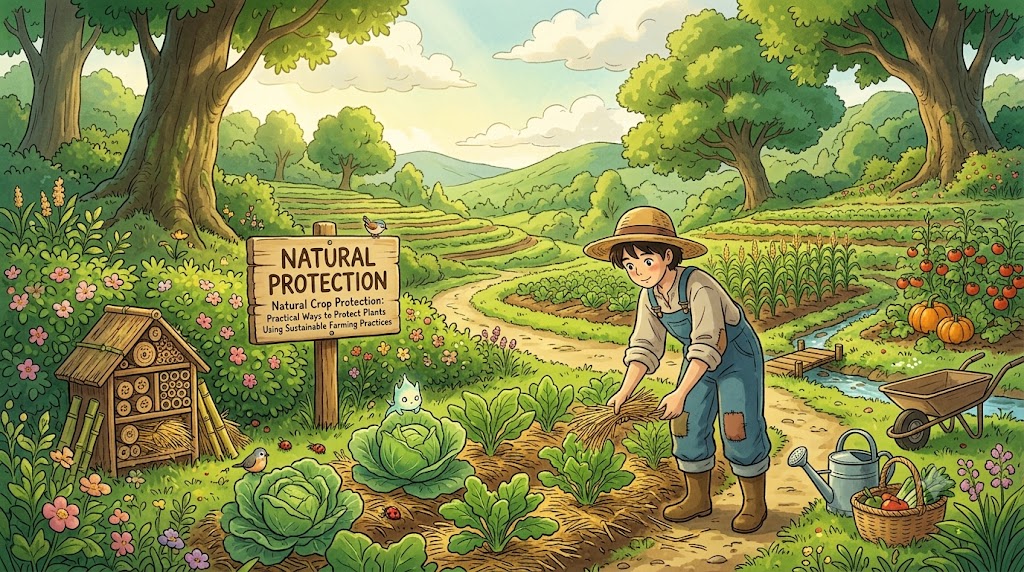
Healthy crops depend on more than good seeds, fertile soil, and regular watering. Plants also face a wide range of challenges during the growing season, including insects, plant diseases, weeds, weather stress, and damage from animals. Farmers have traditionally used different crop protection products and methods to manage these problems, but sustainable agriculture has created greater interest in natural and preventive approaches.
Natural crop protection focuses on keeping plants healthy, reducing conditions that encourage pests and diseases, and using biological, physical, cultural, and ecological methods whenever practical.
The goal is not to eliminate every insect or organism from a farm. A healthy agricultural environment contains many different organisms, and some insects can even be beneficial. Instead, the objective is to maintain a balanced growing system where damaging organisms are monitored and managed before they cause serious crop losses.
Natural crop protection works best as a complete management strategy rather than as a single treatment. Good soil management, crop rotation, sanitation, suitable planting practices, beneficial organisms, physical barriers, and regular field observation can all contribute to healthier crops.
1. Start With Prevention
The simplest form of crop protection is preventing problems before they become difficult to manage.
Many pest and disease problems become worse when plants are already stressed. Poor drainage, overcrowding, weak soil conditions, irregular watering, and unsuitable planting dates can make crops more vulnerable.
A preventive approach begins with basic questions:
Is the crop suitable for the local climate?
Is the soil prepared properly?
Does the field drain excess water effectively?
Are plants receiving adequate light and air movement?
Are damaged plant materials being removed?
Are new seedlings healthy before they enter the field?
These decisions may appear simple, but they can significantly influence crop health.
Instead of waiting until a serious infestation appears, farmers can build protection into the production system from the beginning.
2. Choose Healthy and Suitable Planting Material
Crop protection begins before seeds are planted.
Healthy seeds, seedlings, cuttings, and transplants give a crop a stronger starting point. Planting material showing obvious disease symptoms, severe damage, or poor development can introduce problems into a growing area.
Farmers should select varieties that are appropriate for their local growing conditions and, where available, consider varieties with useful resistance or tolerance to common problems.
Planting material should also be handled carefully during transportation and transplanting.
A strong beginning does not guarantee a pest-free crop, but it can reduce unnecessary stress and improve the crop’s ability to establish successfully.
3. Build Healthy Soil
Healthy soil is one of the foundations of natural crop protection.
Soil supports roots, stores water, provides nutrients, and contains a large community of microorganisms. Poor soil structure can lead to weak root development, waterlogging, nutrient problems, and uneven crop growth.
Farmers can improve soil conditions through practices such as adding suitable organic matter, reducing unnecessary soil disturbance, using cover crops, maintaining appropriate moisture levels, and preventing erosion.
Compost and other properly managed organic materials can contribute to soil structure and biological activity when used appropriately.
The objective is not simply to add more material to the soil. The goal is to create a growing environment where roots can develop effectively and plants can maintain steady growth.
4. Use Crop Rotation
Growing the same crop repeatedly in the same location can create favorable conditions for certain pests, diseases, and weeds.
Crop rotation changes the environment from one season to another.
For example, a farmer may rotate crops with different growth patterns and nutrient requirements rather than continuously planting the same crop family.
Rotation can help interrupt the life cycles of some organisms associated with particular crops. It can also improve overall farm diversity and make the production system less dependent on one type of plant.
A useful rotation plan should consider crop families, planting seasons, nutrient requirements, water needs, and local pest history.
5. Encourage Beneficial Insects
Not every insect found in a field is harmful.
Many insects and other organisms contribute to natural pest control by feeding on pest species or supporting pollination.
Beneficial organisms can include predators and parasitoids that interact with agricultural pests.
Farmers can encourage useful insect populations by maintaining suitable habitat around or within agricultural areas.
Flowering plants, diverse vegetation, and reduced unnecessary disturbance can sometimes provide food and shelter for beneficial organisms.
The key principle is balance.
A field should not be judged simply by the number of insects present. Farmers should learn to distinguish between organisms that damage crops and those that contribute to the agricultural ecosystem.
6. Create Habitat Diversity
Large areas containing only one crop can provide limited habitat diversity.
Introducing appropriate vegetation around field boundaries, maintaining flowering areas, or using carefully selected companion plants can create additional habitat for beneficial organisms.
However, these practices should be planned carefully.
Plants used around fields should not become major competitors for water and nutrients or create new pest problems. They should also be suitable for the local environment.
The purpose of habitat management is to make the farm ecosystem more diverse without creating additional management problems.
7. Use Physical Barriers
Physical protection can be extremely useful, particularly in smaller growing areas.
Examples include insect netting, row covers, plant guards, protective structures, and barriers around sensitive crops.
These methods work by physically reducing access to plants.
For young seedlings, protective covers can provide an additional layer of defense while plants become established.
Physical methods are particularly attractive because they can reduce the need for repeated treatments in certain situations.
Their effectiveness depends on proper installation, ventilation, timing, and regular inspection.
8. Keep the Growing Area Clean
Farm sanitation is an important part of natural crop protection.
Diseased leaves, damaged fruits, fallen plant material, and heavily infested portions of plants can sometimes become sources of continuing problems.
Removing affected material and disposing of it appropriately can help prevent certain issues from spreading.
Tools, containers, trays, and growing areas should also be kept reasonably clean, especially in nurseries and protected cultivation systems.
However, sanitation should be practical rather than excessive.
The goal is to remove material that genuinely creates risk while maintaining a healthy agricultural environment.
9. Manage Water Carefully
Water management can influence both plant health and disease development.
Too little water can stress plants, while excessive irrigation can create weak root conditions and encourage problems associated with prolonged moisture.
Irrigation should therefore match the crop, soil, weather, and growth stage.
Where practical, watering the root zone rather than unnecessarily wetting plant foliage can help reduce moisture remaining on leaves.
Good drainage is equally important.
A well-managed irrigation system supports healthy growth while reducing conditions that may favor certain plant diseases.
10. Improve Air Movement
Plant spacing is sometimes overlooked as a crop protection tool.
When plants are packed too closely together, humidity can remain trapped within the canopy. Limited air movement can create favorable conditions for some diseases.
Appropriate spacing allows better airflow and makes it easier to inspect plants.
Pruning or training may also improve airflow for suitable crops.
However, excessive pruning can stress plants, so techniques should be matched to the specific crop.
Good field design can therefore become part of the protection strategy without requiring additional chemical inputs.
11. Use Mulching Strategically
Mulch can provide several agricultural benefits.
Organic mulch may help conserve soil moisture, moderate soil temperature, reduce erosion, and suppress some weeds.
Reducing weed competition can indirectly support crop health because crops face less competition for water, nutrients, and growing space.
However, mulch should be applied carefully.
Very thick or poorly managed material can create unwanted moisture conditions or provide shelter for certain pests.
The right material, depth, timing, and field conditions should be considered before application.
12. Control Weeds Through Multiple Methods
Weeds compete with crops for resources and can sometimes provide shelter for pests.
Natural weed management can combine several methods instead of depending on one technique.
Farmers may use timely cultivation, hand removal, mulching, crop rotation, cover crops, appropriate spacing, and other cultural practices.
Early weed management is often easier than waiting until weeds become large and well established.
The most effective strategy depends on crop type, field size, available labor, soil conditions, and local weed species.
13. Monitor Crops Regularly
One of the strongest natural protection methods is simply observation.
Farmers should inspect crops regularly instead of waiting for visible damage to become widespread.
During field checks, look for:
Leaf discoloration
Chewed leaves
Unusual spots
Wilting
Damaged stems
Distorted new growth
Insect activity
Eggs or larvae
Unusual plant growth
Changes in soil moisture
Early detection creates more management options.
A small localized problem is generally easier to understand and manage than a problem that has spread throughout an entire field.
14. Use Simple Monitoring Records
Crop monitoring becomes more useful when observations are recorded.
A farmer can maintain a simple field record containing the date, crop stage, weather conditions, observed pests, disease symptoms, affected area, and management action.
Over time, these records can reveal patterns.
For example, a particular problem may appear repeatedly during a certain part of the growing season or after specific weather conditions.
This information can improve future planning.
Instead of treating every season as a completely new situation, farmers can build knowledge from previous observations.
15. Use Traps and Monitoring Tools
Some pests can be monitored using traps or other physical observation tools.
Depending on the crop and pest, farmers may use sticky traps, light-based monitoring, pheromone-based monitoring systems, or other suitable approaches.
The purpose of many traps is not necessarily to eliminate an entire pest population.
They can provide information about whether pest activity is increasing or decreasing.
This distinction is important because good crop protection is based on informed decisions rather than automatically responding to every insect found in a field.
16. Support Natural Predators
Birds, insects, spiders, and other organisms can contribute to the ecological balance of agricultural areas.
Maintaining suitable habitat can sometimes support these natural predators.
Farmers can consider how field boundaries, vegetation, water sources, and surrounding landscape influence local biodiversity.
The approach should remain practical.
Introducing organisms without understanding their behavior or local ecological effects is not the same as supporting naturally occurring beneficial populations.
Natural crop protection works best when farmers understand the ecosystem already present on their land.
17. Use Botanical and Natural Materials Carefully
Certain plant-derived materials and naturally occurring substances are used in agricultural pest management.
Examples may include plant-based preparations, oils, soaps, or other approved natural products.
Natural does not automatically mean harmless.
Some materials can damage plants if applied incorrectly, affect beneficial organisms, or create risks for people, animals, or waterways.
Therefore, any product or preparation should be used according to appropriate agricultural guidance and label instructions where applicable.
The goal is responsible crop protection, not simply replacing one type of product with another.
18. Integrated Natural Crop Protection
The strongest approach combines several methods.
Instead of relying entirely on one solution, farmers can create a layered protection system:
Healthy soil → suitable varieties → proper spacing → crop rotation → habitat diversity → regular monitoring → physical protection → targeted intervention
Each layer addresses a different part of the problem.
If one method is less effective than expected, other practices can still provide protection.
This is why sustainable crop protection should be viewed as a system rather than a single technique.
19. Match Protection Methods to the Problem
Not every crop problem requires the same response.
An insect infestation, fungal disease, nutrient deficiency, weed problem, and weather-related injury may look similar at first.
For example, yellow leaves do not automatically mean an insect attack. The cause could involve watering, nutrient availability, root problems, disease, or environmental stress.
Correct identification should come before treatment.
When farmers are uncertain, they can consult qualified agricultural professionals, extension services, crop specialists, or reliable local agricultural resources.
Accurate diagnosis prevents unnecessary interventions.
20. Create a Seasonal Protection Plan
Natural crop protection becomes easier when planned before the season begins.
A basic plan can include:
Before planting: select suitable varieties, prepare soil, inspect planting material, and plan crop rotation.
During establishment: monitor seedlings, control weeds early, and protect vulnerable plants.
During active growth: inspect regularly, manage irrigation, observe pest populations, and maintain appropriate spacing.
Before harvest: monitor product quality, remove damaged material, and maintain field hygiene.
After harvest: clean equipment, manage crop residues, review records, and prepare improvements for the next cycle.
Planning turns crop protection from an emergency response into a routine management activity.
21. Avoid the “Zero Insects” Mindset
A completely insect-free farm is neither realistic nor necessarily desirable.
Agricultural ecosystems contain many organisms, and some are useful.
The better goal is to maintain crop health and prevent damaging populations from reaching economically significant levels.
This mindset encourages observation and informed decision-making.
Instead of asking, “How do I eliminate every insect?” farmers can ask:
Which organism is present?
Is it actually damaging the crop?
How serious is the damage?
Are natural predators present?
Can the problem be managed without disrupting the broader ecosystem?
These questions lead to more balanced decisions.
22. Measure What Works
Sustainable farming should still be practical and economically realistic.
Farmers should compare different protection strategies based on:
Crop health
Labor requirements
Material costs
Water use
Pest pressure
Disease occurrence
Yield
Product quality
Environmental effects
The best method is not necessarily the one that sounds the most natural.
It is the method that provides reliable protection while fitting the farm’s resources, goals, and environmental conditions.
Final Thoughts
Natural crop protection is built around a simple idea: healthy agricultural systems are often better protected agricultural systems.
Farmers can reduce crop problems by starting with suitable planting material, improving soil health, managing water carefully, rotating crops, encouraging beneficial organisms, using physical barriers, controlling weeds, maintaining sanitation, and monitoring fields regularly.
No single method will solve every crop protection challenge.
The most practical strategy is usually a combination of preventive and responsive practices. Farmers who understand their crops, observe their fields, record recurring problems, and respond early can make better decisions throughout the growing season.
Sustainable crop protection is therefore not about avoiding every modern tool. It is about using resources intelligently and giving natural processes a stronger role in crop management.
By building healthier soil, encouraging biodiversity, improving field conditions, and monitoring crops carefully, farmers can create a more balanced production system that protects plants while making better use of the resources already available on the farm.
The real strength of natural crop protection comes from consistency. A healthy field is rarely created by one action. It is built season after season through better planning, observation, prevention, and responsible management.