If you stand at the edge of an empty field in early spring, it’s easy to feel entirely overwhelmed. Ten years ago, I would stare at my bare acreage and feel a knot of anxiety in my stomach. Back then, my strategy was simple, but flawed: throw seeds in the dirt, fight the weeds, and pray for rain.
Sometimes I got lucky. Most of the time, I barely broke even.
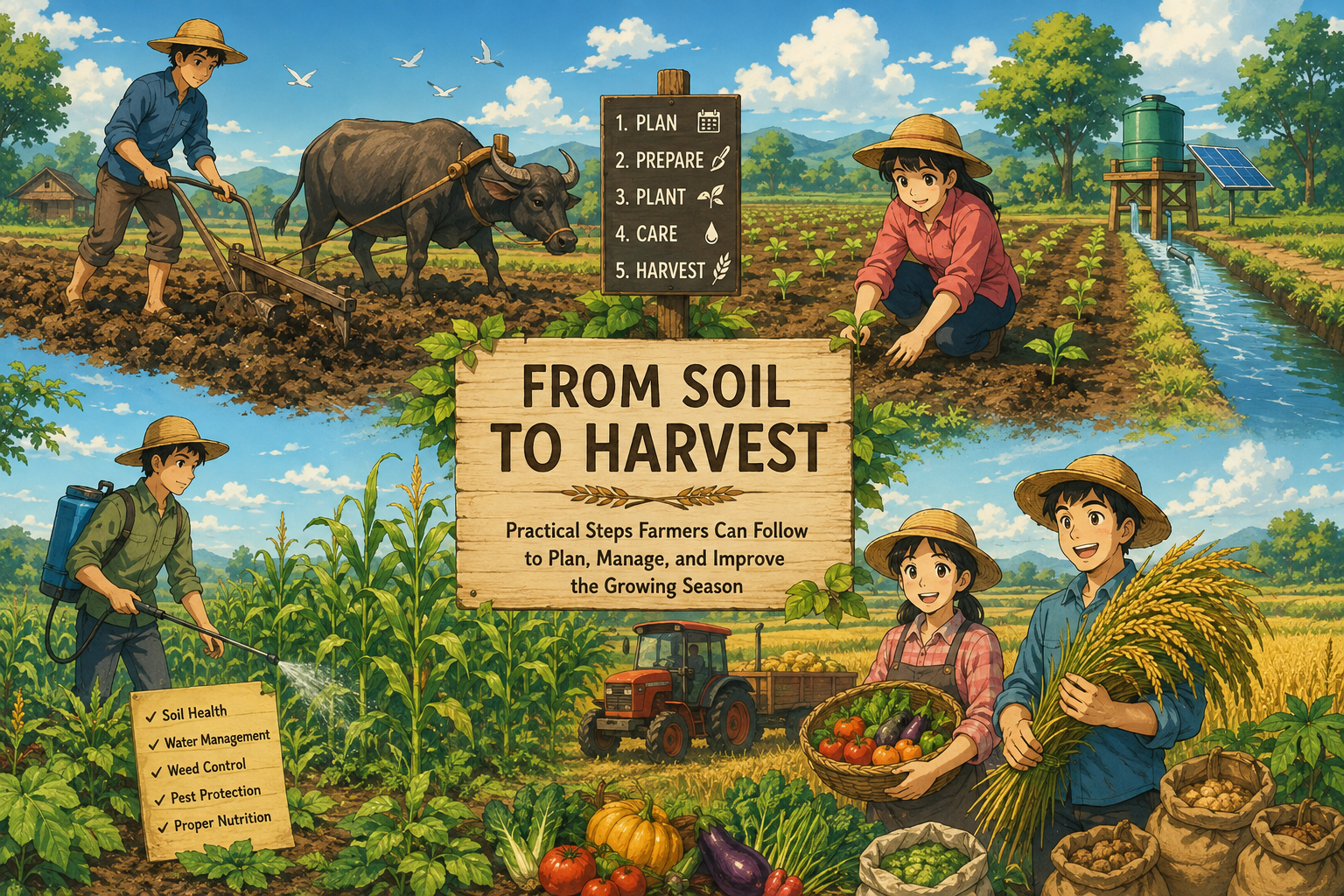
After a decade of calluses, failed crops, and eventual breakthroughs, I realized that successful farming is not a gamble. It is a biological assembly line. You cannot control the weather, but you can absolutely control your systems. Whether you are running a high-tech smart farming operation or focusing on sustainable, regenerative agriculture, the lifecycle of a crop requires a structured approach.
To help you break out of the “plant and pray” mindset, I have organized the growing season into The Five Crucial Milestones. For each milestone, I am going to share the common trap most farmers fall into, and the “Smart Upgrade” that completely changed my farm’s profitability.
Milestone 1: The Foundation (Pre-Season Soil & Data)
Your harvest is essentially a reflection of your soil’s health. You cannot out-farm poor dirt. Period. The work you do before a single seed touches the ground dictates 80% of your eventual yield.
- The Reality Check: Most beginners wait until the ground thaws, aggressively till the soil to a fine powder, and dump a generic, synthetic NPK fertilizer based on what they think the land needs. This destroys soil structure and wastes money.
- The Smart Upgrade (Data-Driven Prep): Treat your farm like a science lab. Before you touch a tractor, get a comprehensive soil test. Modern smart farming relies on data, not guesswork. Once you know your exact mineral deficiencies, you can apply targeted organic amendments. Instead of deep tilling, use broadforks or shallow cultivation to aerate the soil without destroying the mycorrhizal fungi networks that feed your plants.
Farmer’s Rule of Thumb: Never guess your soil’s pH. A pH that is off by just one point can physically lock up nutrients, meaning you could have plenty of calcium in the ground, but your plants literally cannot eat it. Test, don’t guess.
Milestone 2: The Nursery Phase (Germination & Establishment)
This is the most vulnerable stage of a plant’s life. A seedling that gets stressed in its first two weeks will carry that trauma all the way to harvest, resulting in stunted growth and lower yields.
- The Reality Check: Planting seeds based strictly on the dates written on the back of the seed packet. Beginners often plant directly into cold, wet spring soil because the calendar says it is time, leading to massive seed rot and poor germination rates.
- The Smart Upgrade (Micro-Climate Control): Ignore the air temperature; focus entirely on soil temperature. I use cheap digital soil thermometers across my fields. Seeds like corn and beans will simply rot if the soil is below 60°F (15°C). To get a jumpstart, I utilize low tunnels, greenhouse propagation, and heavy compost layers to artificially warm the soil beds weeks before the ambient weather catches up.
Milestone 3: The Vegetative Push (Canopy Building)
Once the plant is established, its only job is to grow “solar panels” (leaves). The larger and healthier the vegetative canopy, the more energy the plant can store to produce massive fruits or grains later.
- The Reality Check: The trap here is over-watering and over-feeding. When a farmer sees a slightly yellow leaf, their panic response is to drown the plant in water and nitrogen. This creates weak, leggy plants with shallow root systems that will collapse during the first summer drought.
- The Smart Upgrade (Targeted Stress & Smart Irrigation): I actually want my plants to struggle just a little bit during this phase. By using drip irrigation and watering deeply but infrequently, I force the roots to drive deep into the earth searching for moisture. Deep roots mean drought resilience. I also utilize foliar feeding (spraying liquid kelp or fish emulsion directly on the leaves) every two weeks to give them micronutrients without overloading the soil with nitrogen.
Farmer’s Rule of Thumb: If you water every day, your plants will wait at the surface for a drink. If you water once a week, they will dig deep to find it themselves.
Milestone 4: The Reproductive Shift (Flowering & Fruiting)
This is the make-or-break moment. The plant switches its energy from growing leaves to reproducing (creating flowers, vegetables, or grains). This phase requires an immense amount of energy and water, and it is highly susceptible to heat stress and pest pressure.
- The Reality Check: Reacting blindly to pests with broad-spectrum sprays that kill both the bad bugs (aphids) and the good bugs (bees). Without pollinators, your flowering crops will yield absolutely nothing.
- The Smart Upgrade (Biological Armor): By this point in my season, my sustainable agriculture practices are doing the heavy lifting. The companion flowers I planted on the borders are drawing in predatory wasps and ladybugs to handle the aphids naturally. Furthermore, I apply a heavy organic mulch (like straw or chopped leaves) around the base of the crops. This regulates the soil temperature during blistering summer days, ensuring the plant doesn’t drop its blossoms due to heat stress.
Milestone 5: The Harvest and The Post-Mortem
Bringing in the crop is exhausting, exhilarating, and deeply satisfying. But the work doesn’t end when the truck is loaded. How you handle the end of the season dictates the beginning of your next one.
- The Reality Check: Rushing the harvest, leaving the field bare, and retreating to the house to collapse. Bare soil left exposed to winter rains will erode, washing all your hard-earned topsoil and nutrients into the nearest creek.
- The Smart Upgrade (The Continuous Loop): Farming is a circle, not a straight line. The moment I pull a crop out of the ground, I immediately seed a cover crop like winter rye or clover. This “living armor” protects the soil biology over the winter and fixes nitrogen for the following spring.
- The Yield Analysis: Finally, I sit down with my yield data. Which crop varieties outperformed the others? Which sections of the field struggled? By treating the harvest as a data-collection event, I guarantee that next year’s crop will be smarter, more efficient, and more profitable than this year’s.
The Bottom Line
When I look at my farm today, I don’t see a wild, untamed piece of nature that I have to fight. I see a biological system that I am managing.
Moving from soil to harvest shouldn’t be a chaotic scramble. By breaking your season down into these five milestones—focusing on soil data, temperature monitoring, smart water management, biological pest control, and continuous soil armor—you remove the guesswork. You stop being a victim of the season, and you finally become the master of your harvest.