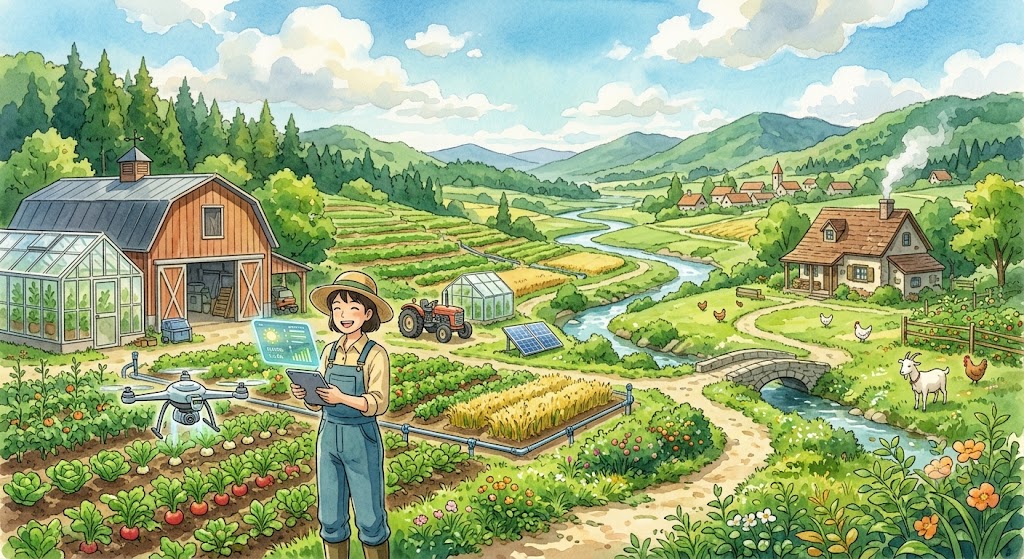
Farming has always depended on hard work, good timing, and close attention to the land. But modern farms are changing quickly. Across the United States, farmers are increasingly combining traditional experience with digital tools, better planning methods, automation, and more efficient equipment.
The goal is not to replace practical farming knowledge. Instead, smart farming habits can help farmers make better use of their time, reduce unnecessary work, monitor crops more closely, and make everyday decisions with better information.
Whether you operate a small family farm, manage livestock, grow specialty crops, or run a large commercial operation, small improvements can make a noticeable difference. The best habits are usually not complicated. They are simple routines that help prevent problems before they become expensive.
Start Each Day With a Simple Farm Plan
A productive farm day usually starts before the first major task begins. Instead of moving from one job to another without a clear order, take a few minutes to identify what actually needs attention.
Weather conditions, equipment needs, livestock routines, irrigation schedules, crop conditions, and seasonal priorities can all affect the day’s workload.
A short morning plan can help answer three basic questions:
- What needs to be done today?
- What is most time-sensitive?
- What can safely wait?
For example, checking an irrigation system may be more important than completing a routine maintenance task if hot weather is expected. Similarly, repairing a piece of equipment before a busy planting or harvesting period can prevent a much larger disruption later.
Farmers do not need complicated software to develop this habit. A phone note, calendar, whiteboard, or farm management application can be enough.
Use Technology Where It Actually Saves Time
Modern agricultural technology can be useful, but buying technology simply because it is new does not automatically make a farm more efficient.
A better approach is to identify a repetitive or time-consuming problem first and then look for technology that solves it.
GPS guidance, field mapping, soil monitoring devices, automated irrigation controls, weather stations, farm-management software, and equipment-monitoring systems can all support different types of operations.
For example, a GPS guidance system can help reduce unnecessary overlap during field operations. A connected weather station can provide more useful local information than relying only on a general weather forecast. Soil-monitoring equipment can help farmers understand moisture conditions in specific areas instead of treating an entire field exactly the same.
The smartest technology is usually the technology that solves a real problem.
Turn Farm Records Into Useful Information
Record keeping is one of those jobs that can feel unimportant when the farm is busy. Yet good records can become one of the most valuable tools for long-term decision-making.
Keep track of important information such as planting dates, input applications, field observations, equipment maintenance, irrigation activity, yields, livestock records, and major weather events.
Over time, these records create a history of the farm.
Suppose a particular field repeatedly produces weaker results under certain conditions. Looking back at previous records may reveal a pattern involving soil moisture, planting timing, fertilizer application, weather, or pest pressure.
The same principle applies to equipment. Maintenance records can help identify machines that repeatedly require repairs, allowing farmers to plan maintenance before peak workloads.
Good records turn everyday farm activity into information that can support better decisions.
Make Equipment Maintenance a Routine
Equipment downtime can become especially expensive during planting and harvest. A machine that stops working during a critical window can affect several other jobs at the same time.
One of the most practical habits is to perform regular checks before equipment is needed for heavy work.
Look at tires, belts, filters, fluids, batteries, lights, hydraulic systems, attachments, and other components according to the manufacturer’s recommendations.
Do not wait for a major failure before paying attention to small warning signs.
A strange noise, unusual vibration, leaking fluid, reduced performance, or repeated starting problem may indicate an issue that should be investigated.
Keeping commonly needed replacement items and basic maintenance supplies organized can also save valuable time. Spending a few minutes preparing equipment today can sometimes prevent hours of downtime later.
Organize Supplies So Workers Can Find Them Quickly
A surprising amount of farm time can disappear through small organizational problems.
Tools, replacement parts, irrigation supplies, animal-care equipment, safety gear, and other materials should have designated storage areas.
Clear labels can make a major difference, particularly when multiple people work on the farm.
Instead of keeping frequently used items wherever there happens to be space, create simple locations for them. A basic storage system might divide supplies into categories such as equipment maintenance, irrigation, crop work, livestock care, and safety.
This makes the farm easier to manage and can reduce repeated trips between buildings, fields, and storage areas.
Efficiency is not always about working faster. Sometimes it is simply about avoiding unnecessary movement.
Watch Fields More Regularly Instead of Waiting for Problems
Walking fields and checking crops remains valuable even when farms use advanced technology.
Satellite imagery, drones, sensors, and digital mapping can provide useful information, but physical observation can reveal details that technology may not immediately explain.
Look for unusual plant growth, standing water, erosion, damaged plants, weed pressure, signs of insects, equipment tracks, and changes in soil conditions.
The important habit is consistency.
A farmer who checks fields regularly may notice a developing problem while it is still limited to a small area. Waiting until the problem becomes obvious across an entire field can make management more difficult and expensive.
Technology and hands-on observation work best when they support each other.
Use Weather Information for Better Timing
Weather affects almost every part of farm management.
Instead of checking the forecast only when severe weather is approaching, make weather monitoring part of the daily routine.
Farmers can consider expected temperature, rainfall, wind, humidity, soil moisture, and longer-term weather patterns when planning field operations.
Weather information can help with decisions such as when to work a field, when to inspect irrigation, when to protect sensitive crops, or when equipment should be moved or secured.
However, forecasts are not perfect. Local field conditions can differ significantly from broader regional forecasts. Combining weather information with actual field observations provides a stronger basis for decisions.
Reduce Repeated Trips Around the Farm
One of the easiest efficiency improvements is to reduce unnecessary travel.
Before leaving a shop, barn, or storage area, think about everything that needs to be taken to the next location.
If tools, parts, supplies, and equipment are needed in the same field, moving them together can eliminate multiple trips.
The same concept can be applied to livestock routines, maintenance work, and crop inspections.
Creating logical routes for regular tasks can save fuel, time, and physical effort.
For larger farms, mapping regular routes can also help employees understand where supplies and equipment should be delivered.
Small improvements repeated every day can eventually become significant time savings.
Build a Weekly Review Habit
Daily planning handles immediate priorities, but a weekly review helps farmers think beyond today’s workload.
Once a week, spend some time reviewing what was completed, what was delayed, what problems appeared, and what needs attention next.
Ask questions such as:
- Which tasks consumed the most time?
- Did any equipment cause repeated problems?
- Were there unexpected crop or livestock issues?
- Which supplies need to be reordered?
- What important jobs are coming up?
- Can any task be simplified?
This review does not need to take an hour. Even 15 to 20 minutes can provide useful perspective.
Over several months, these reviews can reveal recurring problems that may otherwise become part of the normal routine.
Train Everyone to Follow the Same Basic Systems
A farm becomes more efficient when everyone understands how important tasks should be handled.
This does not mean every worker needs to perform tasks in exactly the same way. But basic procedures should be clear.
For example, workers should know where tools belong, how equipment problems should be reported, where safety equipment is stored, how livestock observations should be recorded, and which tasks require immediate attention.
Simple written instructions can be particularly helpful during busy seasons or when temporary workers join the operation.
Clear communication reduces mistakes and makes it easier for farm managers to know what has already been completed.
Focus on Small Improvements Instead of Trying to Change Everything
One of the biggest mistakes farmers can make when improving efficiency is attempting to change the entire operation at once.
A better approach is to identify one recurring problem and improve it.
Maybe equipment inspections take too long. Maybe supplies are difficult to locate. Maybe field observations are not being recorded consistently. Maybe employees spend too much time traveling back and forth for tools.
Choose one problem, test a practical solution, and measure whether it helps.
If the improvement works, keep it. Then move on to the next issue.
This gradual approach is more realistic for many American farms because farming already involves changing weather, seasonal workloads, equipment limitations, labor availability, and unpredictable field conditions.
Final Thoughts
Smart farming is not simply about purchasing expensive equipment or adopting the newest agricultural technology. It is about building better habits around planning, observation, maintenance, organization, communication, and decision-making.
For farmers across the United States, even modest improvements can make daily operations more manageable. A better morning plan, organized tools, consistent equipment checks, reliable records, regular field walks, and carefully selected technology can all contribute to a more efficient operation.
The strongest farms are not necessarily the ones using the most technology. They are often the ones that understand their own challenges and use the right tools and habits to solve them.
Start with one area that wastes time or creates unnecessary work. Improve that system, monitor the result, and then tackle the next one.
Over time, those small improvements can become part of the farm’s everyday routine—and that is where real efficiency begins.