A healthy crop does not depend only on water, fertilizer, and sunlight. Farmers also need to protect plants from insects, diseases, weeds, and other problems that can reduce crop quality and productivity. However, pest management does not always have to mean immediately reaching for strong chemical pesticides.
Natural pest management uses a combination of prevention, observation, beneficial organisms, good farming practices, and carefully selected treatments. The goal is not necessarily to eliminate every insect from a farm. Instead, it is to keep harmful pest populations at manageable levels while protecting pollinators, soil organisms, water, and other parts of the farm ecosystem.
This approach can make agricultural land more balanced and resilient over time. When farmers understand how pests interact with crops and their surrounding environment, they can often prevent small problems from becoming serious infestations.
Start With Prevention Instead of Waiting for an Infestation
One of the simplest principles of natural pest management is prevention.
Pests are often easier to manage when their numbers are still low. Regularly walking through fields and checking leaves, stems, flowers, and fruit can help farmers identify early warning signs.
Look for:
- Small holes or unusual leaf damage
- Discolored or curled leaves
- Insects or eggs on the underside of leaves
- Sticky substances on plant surfaces
- Wilting or unusual growth
- Damaged fruits or stems
Early observation gives farmers more options. A small affected area may be manageable through physical removal or targeted treatment, while a large infestation can require considerably more effort.
Keeping simple records can also help. If the same pest appears every year during a particular part of the growing season, farmers can prepare preventive measures in advance.
Encourage Beneficial Insects
Not every insect found on a farm is a threat.
Many insects actually help farmers by feeding on crop pests or supporting pollination. Lady beetles, lacewings, praying mantises, predatory bugs, and other beneficial organisms can contribute to natural pest control.
Instead of trying to remove every insect from a field, farmers can create conditions where beneficial species are more likely to remain.
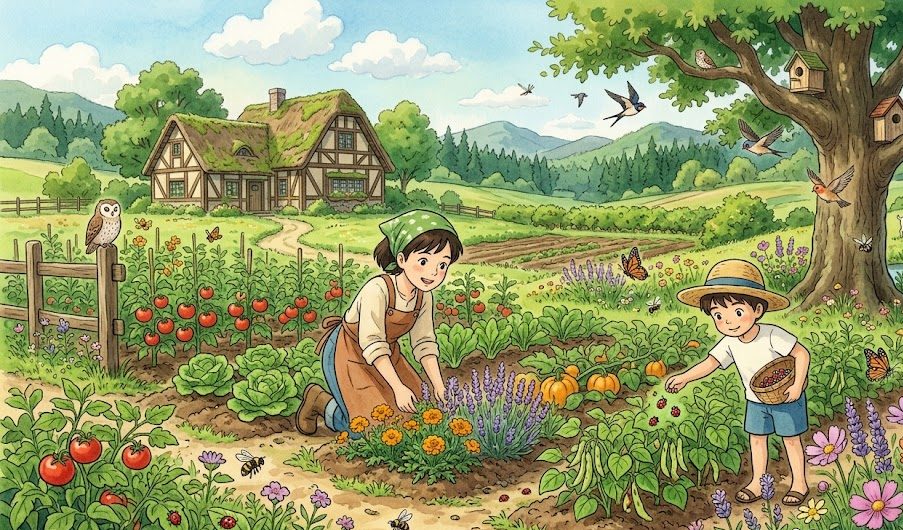
Flowering plants around field borders can provide nectar and shelter for certain beneficial insects. A diverse farm environment can also offer habitats for predators that naturally feed on pest populations.
This creates an important distinction between pest control and insect elimination. A healthy farm ecosystem contains many organisms, and some of them can become natural partners in protecting crops.
Use Crop Rotation to Break Pest Cycles
Growing the same crop in the same location repeatedly can make it easier for certain pests and diseases to establish themselves.
Crop rotation changes the environment from one growing season to another. For example, farmers may rotate crops from different plant families rather than continuously growing the same crop.
This can make it more difficult for pests that depend heavily on a particular host plant to maintain large populations.
Crop rotation can also contribute to broader soil-management goals. Different crops have different root structures and nutrient requirements, so a well-planned rotation can support more diverse agricultural systems.
The exact rotation should be adapted to local climate, soil conditions, crop choices, and known pest problems.
Keep the Farm Area Clean and Well Managed
Good farm hygiene can play a surprisingly important role in pest management.
Dead plant material, heavily infected leaves, fallen fruit, weeds, and crop residues can sometimes provide shelter or food for pests and disease organisms.
Removing severely affected plant material and managing crop residues appropriately can reduce potential sources of future problems.
However, farmers should avoid removing every piece of vegetation simply because it is present. Some plants can provide habitat for beneficial insects and other organisms.
The goal is balanced management rather than creating a completely empty landscape.
Choose Pest-Resistant Crop Varieties
Plant selection can influence how vulnerable a crop is to pest damage.
Some crop varieties have characteristics that make them less attractive or less susceptible to particular pests or diseases. Selecting varieties suited to local growing conditions can therefore be an important part of prevention.
When choosing seeds or planting material, farmers can consider:
- Local climate suitability
- Common pest problems
- Disease resistance
- Expected growing period
- Market demand
- Water requirements
A variety that performs well under local conditions may have a better chance of staying healthy than one that is poorly suited to the environment.
Physical Barriers Can Protect Young Plants
Farmers do not always need a chemical or biological treatment to stop pests from reaching crops.
Physical barriers can provide a simple first line of defense. Fine mesh, insect netting, row covers, protective screens, and similar materials can prevent certain insects from reaching plants.
These methods can be particularly useful for young or high-value crops.
The effectiveness of a barrier depends on selecting an appropriate material and installing it correctly. Farmers also need to consider ventilation, temperature, pollination requirements, and the possibility of pests already being trapped inside the protected area.
Physical protection is most useful when it is combined with regular crop inspection.
Maintain Healthy Soil
The relationship between pest management and soil health is sometimes overlooked.
Healthy soil supports strong root development and provides plants with access to essential nutrients and water. Plants growing under suitable conditions may be better able to tolerate certain environmental stresses.
Farmers can support soil health through practices such as adding appropriate organic matter, reducing unnecessary soil disturbance, preventing erosion, and maintaining suitable soil moisture.
However, healthy soil should not be viewed as a guaranteed shield against pests. Pest problems can still occur even in well-managed fields. Soil health is better understood as one part of a broader crop-management system.
Use Natural Treatments Carefully
Some farmers use plant-based or other naturally derived treatments to manage pests. These may include certain botanical preparations, soaps, oils, or other approved products.
“Natural” does not automatically mean harmless.
Some natural substances can damage plants, affect beneficial insects, contaminate water, or cause problems when used incorrectly. The concentration, application method, weather conditions, and target pest all matter.
Farmers should therefore identify the pest before choosing a treatment and follow the product label or guidance from a qualified agricultural professional when using a commercial product.
Targeted application is generally preferable to treating an entire field unnecessarily.
Attract Birds and Other Natural Predators
Birds and other wildlife can contribute to a balanced farm ecosystem.
Certain bird species feed on insects, while other predators can help limit populations of rodents and other agricultural pests. Providing suitable habitat can sometimes encourage these natural relationships.
Trees, hedges, nesting areas, and diverse vegetation can provide shelter and food for wildlife.
Of course, wildlife management must be appropriate for the particular farm. Some animals that help control one pest may also damage crops. The objective is to encourage beneficial ecological relationships while protecting the crop itself.
Avoid Creating Conditions That Favor Pests
Farm management decisions can influence whether a pest finds the field attractive.
Excessive irrigation, overcrowded planting, poor airflow, unmanaged weeds, and inappropriate fertilizer applications can sometimes contribute to crop stress or create favorable conditions for certain pests and diseases.
Proper spacing can improve air circulation. Appropriate irrigation can reduce unnecessary moisture. Timely weed management can reduce competition and potential pest habitats.
These small decisions work together.
Instead of treating pest control as a separate activity, farmers can incorporate it into everyday crop management.
Monitor Before You Act
One of the most important ideas in environmentally responsible pest management is monitoring.
Finding one insect does not necessarily mean the entire crop needs treatment. Farmers should determine what species is present, how many plants are affected, how quickly the population is increasing, and whether meaningful crop damage is occurring.
Simple monitoring methods can include visual inspections, sticky traps, pheromone traps for appropriate pests, and regular field scouting.
When farmers have better information, they can make more targeted decisions.
This approach can reduce unnecessary treatments while ensuring that serious pest problems are addressed before they become difficult to manage.
A Balanced Approach Works Best
Natural pest management is not about choosing one technique and expecting it to solve every problem.
A stronger strategy combines multiple methods:
Observe → Identify → Prevent → Encourage beneficial organisms → Protect plants → Treat only when necessary → Monitor results.
This approach is often associated with integrated pest management, where farmers combine biological, cultural, physical, and other suitable control methods based on the actual situation.
The advantage of combining methods is that the farm does not become dependent on a single solution.
Building a Healthier Farm for the Long Term
Protecting crops and protecting the surrounding ecosystem do not have to be competing goals.
A farm can produce food while also providing habitat for beneficial insects, supporting soil organisms, reducing unnecessary chemical use, and protecting water resources. Achieving that balance requires observation and thoughtful management.
Natural pest control may take more planning than simply applying a broad treatment whenever insects appear, but it can encourage farmers to understand their fields more deeply.
The most effective strategy will depend on the crop, climate, pest species, farm size, and local conditions. By combining prevention, crop diversity, healthy soil, beneficial organisms, physical protection, and careful monitoring, farmers can create a more resilient production system.
Ultimately, a healthy farm ecosystem is not one without insects. It is one where different organisms exist in balance and harmful pest populations are managed before they can cause serious damage. That balance can help farmers protect their crops while building agricultural systems that remain productive and sustainable for years to come.