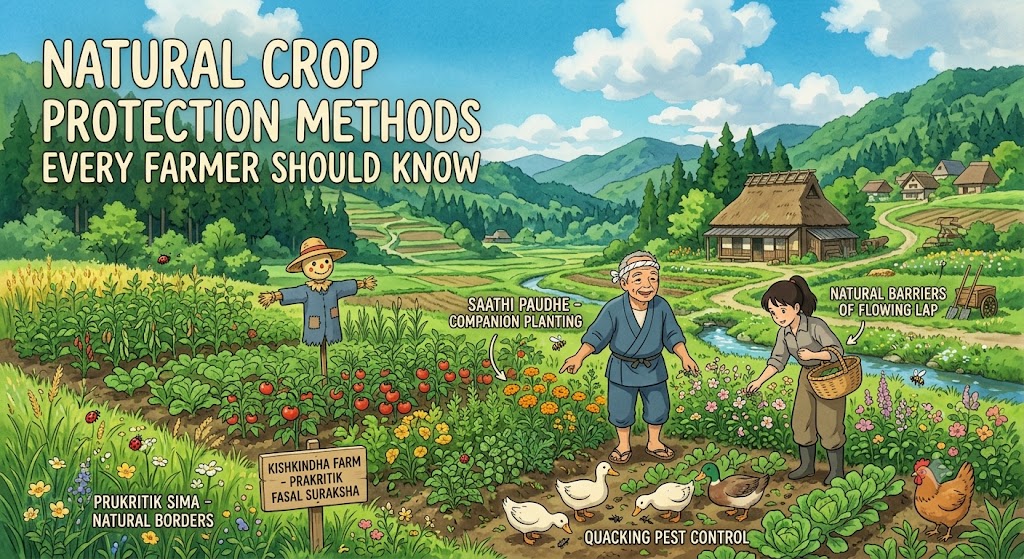
Protecting crops from insects, diseases, weeds, birds, and harmful weather conditions is one of the biggest challenges in farming. Many farmers depend heavily on chemical pesticides because they provide fast results. However, repeated and unnecessary chemical use can damage soil organisms, contaminate water, harm beneficial insects, increase production costs, and create pesticide resistance.
Natural crop protection focuses on preventing problems before they become serious. It combines healthy soil management, crop diversity, biological control, farm hygiene, physical barriers, and carefully prepared plant-based solutions. These methods do not always eliminate every pest, but they help farmers maintain pest populations below damaging levels.
Natural protection is especially useful for small farms, organic farms, vegetable gardens, orchards, and farmers who want to reduce chemical costs. The following methods can help protect crops while supporting long-term farm health.
Start With Healthy Soil
Healthy soil produces stronger plants, and strong plants are generally better able to resist insects and diseases. Weak crops growing in compacted or nutrient-deficient soil are more likely to suffer from pest attacks.
Farmers can improve soil health by adding:
- Well-decomposed compost
- Farmyard manure
- Crop residues
- Green manure
- Vermicompost
- Organic mulch
Regular soil testing is also important. Applying too much nitrogen can create soft, leafy growth that attracts sap-sucking pests such as aphids and whiteflies. Balanced nutrition supports steady plant growth and improves natural resistance.
Choose Resistant Crop Varieties
Selecting the right seed is one of the easiest ways to reduce crop losses. Some crop varieties naturally tolerate specific diseases, insects, drought conditions, or local weather problems.
Before planting, farmers should consider:
- Local climate
- Common regional pests
- Disease history of the field
- Soil type
- Water availability
- Crop duration
Locally adapted varieties often perform better because they are already suited to the surrounding conditions. Certified and disease-free seeds can also reduce the risk of introducing infections into the field.
Use Crop Rotation
Growing the same crop repeatedly in one field allows certain pests and diseases to survive and multiply. Crop rotation breaks their life cycle by replacing the host crop with an unrelated crop.
For example, a farmer may rotate:
- A cereal crop
- A legume crop
- A leafy vegetable
- A root crop
Crop rotation can reduce soil-borne diseases, balance nutrient use, control weeds, and improve soil fertility. Rotating deep-rooted and shallow-rooted crops also helps plants use nutrients from different soil layers.
Practise Companion Planting
Companion planting means growing selected plants together because they support or protect one another. Some companion plants confuse pests, attract pollinators, provide shade, or bring beneficial insects into the field.
Useful combinations may include:
- Tomatoes with basil
- Cabbage with marigold
- Carrots with onions
- Maize with beans
- Fruit trees with flowering herbs
Marigold is often planted near vegetables because its strong smell may discourage certain pests. Flowering plants such as coriander, dill, sunflower, and buckwheat can attract beneficial insects that feed on harmful pests.
Companion planting should be planned carefully because not every plant combination works well in every climate.
Encourage Beneficial Insects
Not all insects are harmful. Many insects naturally control crop pests.
Important beneficial insects include:
| Beneficial Insect | Pests It May Control |
|---|---|
| Ladybirds | Aphids and soft-bodied insects |
| Lacewings | Aphids, whiteflies, and small larvae |
| Parasitic wasps | Caterpillars, aphids, and pest eggs |
| Hoverflies | Aphids |
| Ground beetles | Soil insects, larvae, and slugs |
| Praying mantis | Various small insects |
Farmers can attract these natural predators by growing flowering plants around field borders. Reducing broad-spectrum pesticide use also helps beneficial populations survive.
When harmful and beneficial insects are correctly balanced, farms can develop a natural pest-control system.
Install Physical Barriers
Physical barriers prevent pests from reaching crops. They are particularly effective for nurseries, vegetable fields, and high-value crops.
Common barriers include:
- Insect-proof nets
- Row covers
- Fruit bags
- Tree guards
- Bird nets
- Sticky bands
- Mulch sheets
Fine mesh can protect young plants from moths, beetles, and flies. Fruit bags can protect mangoes, guavas, apples, and other fruits from insects and birds.
Barriers should be installed before pest pressure becomes high. They must also allow enough sunlight, ventilation, and moisture to reach the crop.
Use Traps for Monitoring and Control
Traps help farmers detect pests early and reduce their population.
Yellow Sticky Traps
Yellow sticky traps attract whiteflies, aphids, leaf miners, and certain flying insects. They are commonly used in vegetable fields and protected cultivation.
Blue Sticky Traps
Blue traps are often used for monitoring thrips.
Pheromone Traps
Pheromone traps attract specific male insects using natural scent signals. They are useful for monitoring moths, fruit borers, and other crop pests.
Light Traps
Light traps attract night-flying insects. However, they should be used carefully because they can also capture beneficial insects.
Farmers should inspect traps regularly and record pest numbers. A sudden rise can indicate that additional control action is needed.
Apply Neem-Based Solutions
Neem is one of the most widely used natural crop-protection materials. Neem seed extracts and neem oil can interfere with insect feeding, growth, egg-laying, and reproduction.
Neem-based products may help manage:
- Aphids
- Whiteflies
- Mealybugs
- Caterpillars
- Leaf-eating insects
- Certain beetles
Neem works best when applied during the early stages of pest infestation. It should usually be sprayed during cooler parts of the day to reduce the risk of leaf damage.
Farmers should follow proper mixing instructions because overly concentrated neem solutions can harm sensitive crops.
Use Soap Sprays Carefully
Mild insecticidal soap can help control soft-bodied pests by damaging their outer protective layer.
It may be useful against:
- Aphids
- Mites
- Whiteflies
- Mealybugs
- Young scale insects
The spray must directly contact the pest to work effectively. It is advisable to test it on a small section of the crop before spraying the entire field.
Household detergents should not be used without caution because some contain chemicals that may burn leaves.
Prepare Botanical Extracts
Farmers in many regions use plant-based extracts as low-cost pest repellents. Common ingredients include:
- Garlic
- Chilli
- Neem leaves
- Ginger
- Onion
- Tobacco alternatives permitted under local rules
- Aromatic herbs
Garlic and chilli sprays may discourage certain chewing and sucking insects. However, homemade preparations can vary greatly in strength. Farmers should use gloves, avoid contact with eyes, test solutions on a few plants, and never assume that a natural product is automatically harmless.
Botanical sprays should be treated as supportive tools rather than the only pest-control method.
Keep the Farm Clean
Farm sanitation is one of the most effective but overlooked protection methods. Diseased leaves, rotten fruits, infected branches, and leftover crop material can become breeding sites for pests and pathogens.
Good sanitation includes:
- Removing infected plants
- Collecting fallen fruits
- Cleaning farming tools
- Managing weeds
- Destroying heavily infested residues
- Cleaning irrigation channels
- Using clean planting trays
Tools should be disinfected when moving between infected and healthy fields. Workers should also avoid spreading contaminated soil through footwear or equipment.
Manage Water Correctly
Both too much and too little water can increase crop problems.
Overwatering may encourage:
- Root rot
- Fungal diseases
- Nutrient loss
- Weak root development
- Snail and slug activity
Underwatering weakens crops and increases heat stress.
Drip irrigation is often a better option than overhead watering because it delivers water near the roots while keeping leaves relatively dry. Watering early in the day also allows wet foliage to dry faster.
Proper field drainage is essential during rainy periods.
Use Mulching
Mulching protects the soil surface with organic or synthetic material.
Organic mulches include:
- Straw
- Dry leaves
- Grass clippings
- Crop residues
- Wood chips
Mulching helps suppress weeds, retain moisture, stabilise soil temperature, and reduce soil splash that can spread diseases onto leaves.
The mulch layer should not touch plant stems directly because constant moisture around the stem may encourage rot.
Remove Weeds Before They Spread
Weeds compete with crops for light, water, space, and nutrients. They can also provide shelter for insects and act as alternative hosts for crop diseases.
Natural weed-management methods include:
- Hand weeding
- Shallow hoeing
- Mulching
- Cover cropping
- Crop rotation
- Solarisation
- Stale seedbed technique
Removing weeds before they produce seeds can greatly reduce future infestations. Farmers should pay special attention to field borders, irrigation channels, and unused corners.
Use Trap Crops
A trap crop is planted to attract pests away from the main crop. Once pests gather on the trap crop, they can be removed or controlled in a limited area.
Examples may include:
- Mustard near cabbage
- Marigold near tomato
- Sunflower near selected vegetable crops
- Napier grass near maize
Trap crops should be planted at the correct time and monitored regularly. If ignored, they may become pest breeding centres instead of providing protection.
Protect Crops From Birds and Animals
Birds and animals can cause serious losses during seedling, flowering, and fruiting stages.
Natural protection methods include:
- Reflective ribbons
- Scare devices
- Netting
- Fencing
- Guard crops
- Motion-based deterrents
- Tree guards
Scare devices should be moved frequently because birds quickly become familiar with stationary objects. Netting is often the most reliable option for high-value fruit and vegetable crops.
Follow Integrated Pest Management
Integrated Pest Management, commonly called IPM, combines multiple protection methods rather than depending on a single treatment.
A practical IPM programme includes:
- Inspecting crops regularly
- Identifying the exact pest or disease
- Measuring the level of damage
- Using preventive methods
- Protecting beneficial insects
- Applying biological or botanical controls
- Using selective pesticides only when necessary
- Recording the results
The goal is not to kill every insect. It is to prevent pest populations from reaching levels that cause unacceptable economic damage.
Avoid Common Natural Protection Mistakes
Natural methods can fail when farmers use them incorrectly. Common mistakes include:
- Spraying without identifying the pest
- Using overly concentrated homemade mixtures
- Applying treatments during extreme heat
- Ignoring the underside of leaves
- Waiting until infestation becomes severe
- Mixing incompatible products
- Using contaminated seeds
- Failing to monitor fields
- Assuming every insect is harmful
Correct pest identification is especially important. A spray meant for aphids may not work against caterpillars or fungal infections.
Frequently Asked Questions
Are natural crop protection methods effective?
Yes, especially when several methods are used together. Prevention, monitoring, biological control, crop rotation, and farm hygiene usually provide better results than relying on one homemade spray.
Can natural methods completely replace pesticides?
In some farming systems, pesticide use can be greatly reduced. However, severe infestations may still require approved and carefully selected products. The safest approach is to use pesticides only when necessary.
How often should farmers inspect crops?
Fields should ideally be inspected at least once or twice a week. During flowering, fruiting, or known pest seasons, more frequent monitoring may be required.
Is neem safe for every crop?
Neem is widely used, but sensitive plants may react to strong concentrations. Farmers should always test the mixture on a small area first.
What is the best natural method for beginners?
Beginners should start with healthy soil, resistant seeds, crop rotation, regular field inspection, sanitation, mulching, and simple traps.
Conclusion
Natural crop protection is not based on one miracle product. It is a complete farming strategy that combines healthy soil, strong seeds, biological diversity, clean fields, careful monitoring, and timely action.
By adopting methods such as crop rotation, companion planting, neem solutions, beneficial insects, physical barriers, traps, mulching, and proper irrigation, farmers can reduce crop damage without becoming fully dependent on harsh chemicals.
The best results come from prevention. Farmers who inspect their fields regularly and act during the early stages of a problem can protect yields, lower production costs, preserve beneficial organisms, and build a healthier farming system for the future.