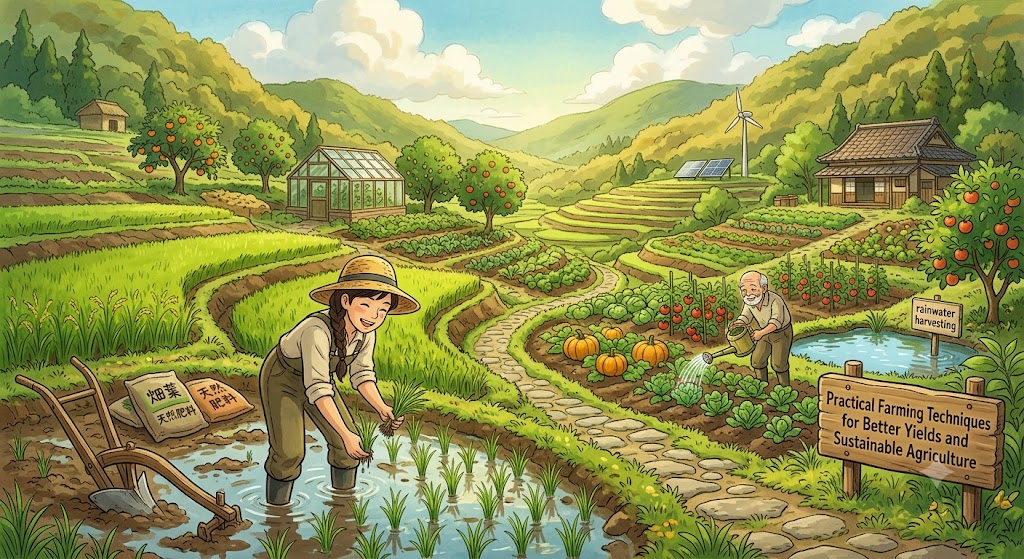
Modern farming is no longer only about growing more crops on a larger area. Successful agriculture now depends on producing better yields while protecting soil, saving water, reducing unnecessary costs, and keeping the farm productive for future seasons. This is where practical farming techniques become important.
Practical farming focuses on simple, field-tested methods that farmers can apply without completely changing their existing system. These techniques combine traditional knowledge with modern planning, helping farmers improve productivity while reducing damage to natural resources.
The best results usually come from small improvements made consistently. Better seed selection, correct irrigation, timely crop monitoring, and healthier soil management can often create a bigger impact than expensive equipment used without proper planning.
Begin With a Clear Farm Plan
A productive season starts before seeds enter the soil. Farmers should first study the field, local climate, available water, expected market demand, and previous crop performance.
Planting a crop simply because it was profitable last year can be risky. Market prices, rainfall, pest pressure, and input costs can change. A basic farm plan helps farmers choose crops that match their soil, climate, budget, and selling opportunities.
The plan should include the sowing date, seed quantity, irrigation schedule, fertilizer requirement, labour needs, expected harvest time, and likely selling channel.
Keeping written records is equally valuable. Farmers who record expenses, yields, pest problems, and weather conditions can identify which decisions worked and which ones caused losses. Even a simple notebook can become an important farm-management tool.
Improve Soil Before Expecting Higher Yields
Crop productivity depends heavily on soil condition. Applying more fertilizer cannot fully solve problems caused by compacted soil, low organic matter, poor drainage, or an incorrect soil pH.
Soil testing should be done periodically to understand nutrient availability and pH levels. This prevents farmers from spending money on fertilizers that the crop may not need.
Organic matter can be improved through compost, farmyard manure, crop residues, green manure, and cover crops. These materials support beneficial microorganisms and improve the soil’s ability to hold water and nutrients.
Farmers should also avoid excessive ploughing. Frequent deep tillage breaks soil structure, increases moisture loss, and disturbs useful organisms. Reduced tillage or shallow cultivation can help preserve soil health while lowering fuel and labour expenses.
Healthy soil does not improve overnight. However, farmers who regularly add organic matter and avoid unnecessary disturbance usually see better root development and more stable yields over time.
Select Quality Seeds and Suitable Varieties
Good-quality seeds provide the foundation for a healthy crop. Poor or infected seeds may lead to weak germination, uneven plant growth, and early disease problems.
Farmers should select certified seeds whenever possible and choose varieties suited to local conditions. A high-yielding variety developed for an irrigated area may perform poorly in a dry region.
Important factors include crop duration, drought tolerance, disease resistance, market demand, and local temperature.
Before sowing, farmers can conduct a simple germination test. A small number of seeds are placed on a moist cloth and monitored for sprouting. If germination is low, the seed rate may need adjustment or the seed lot may need replacement.
Seed treatment is another practical step. Approved biological or protective treatments can reduce the risk of seed-borne and soil-borne diseases during the early growth stage.
Use Water According to Crop Needs
Water shortages and rising irrigation costs make efficient water management essential. Overwatering wastes water, removes nutrients from the root zone, and encourages diseases. Underwatering reduces plant growth and lowers yield.
The correct irrigation schedule depends on crop type, soil texture, weather, and growth stage. Young plants may need lighter irrigation, while flowering and fruit development often require more consistent moisture.
Drip irrigation delivers water close to the roots and reduces evaporation. Mulching further improves efficiency by covering the soil surface and slowing moisture loss.
| Water-Saving Method | Practical Benefit |
|---|---|
| Drip irrigation | Delivers water directly near roots |
| Mulching | Reduces evaporation and weed growth |
| Rainwater harvesting | Stores water for dry periods |
| Early-morning irrigation | Lowers evaporation losses |
| Field levelling | Improves even water distribution |
Farmers should check soil moisture before irrigating instead of following a fixed calendar blindly. A field may require less water after rain or during cooler weather.
Feed Crops in the Right Quantity and at the Right Time
Fertilizer management is most effective when nutrients are applied according to crop demand. Applying the entire amount at one time may cause nutrient loss and weak plant growth.
Splitting fertilizer applications allows crops to receive nutrients during important stages such as early growth, flowering, and grain or fruit development.
Organic sources improve long-term soil fertility, while mineral fertilizers can provide nutrients quickly. A balanced approach often gives better results than relying only on one source.
Farmers should pay attention to micronutrients as well. Deficiencies of zinc, boron, iron, or sulphur can reduce crop quality even when nitrogen, phosphorus, and potassium are available.
Leaf colour, plant height, root condition, and fruit development can provide early signs of nutrient problems. However, visual symptoms should ideally be confirmed through soil or plant testing before treatment.
Protect Crops Through Regular Monitoring
Many crop losses occur because pests or diseases are noticed too late. A farmer who walks through the field regularly can identify early signs before the problem spreads.
Leaves should be checked from both sides, especially around field borders where infestations often begin. Farmers should look for holes, discolouration, eggs, insects, wilted plants, unusual growth, and damaged fruits.
Natural predators, traps, resistant varieties, crop rotation, and field sanitation should be used first whenever suitable. Chemical pesticides should be applied only when pest levels are likely to cause serious economic damage.
Correct pest identification is essential. Spraying the wrong product wastes money and may kill beneficial insects without solving the actual problem.
A practical monitoring routine can save far more money than emergency spraying after severe damage has occurred.
Rotate Crops and Diversify the Farm
Growing the same crop repeatedly increases the risk of pest buildup, disease, and nutrient depletion. Crop rotation breaks these cycles and improves soil use.
A cereal crop can be followed by a legume, vegetable, or root crop. Legumes such as peas, beans, and clover may improve nitrogen availability for the next crop.
Farm diversification can also protect income. Farmers who depend on only one crop face greater risk if prices fall or weather damages the harvest. Combining field crops with vegetables, fruit trees, livestock, poultry, beekeeping, or fish farming can create multiple income sources.
Diversification should be gradual. Farmers should begin with activities they can manage using available land, labour, water, and market access.
Reduce Post-Harvest Losses
Producing a good crop does not guarantee profit if a large part is damaged after harvest. Poor handling, delayed transport, moisture, pests, and improper storage can reduce quality quickly.
Harvesting should take place at the correct maturity stage. Produce should be handled gently and kept away from direct sunlight whenever possible.
Grains must be dried to a safe moisture level before storage. Vegetables and fruits should be sorted, cleaned, packed, and transported carefully.
Simple improvements such as clean containers, ventilated storage rooms, raised platforms, and proper packaging can protect both quantity and market value.
Farmers may also increase income by grading produce, selling directly to consumers, processing crops, or forming groups to access larger markets.
Farmer’s Practical Tip
Do not introduce several major changes across the entire farm in one season. Test a new seed variety, irrigation method, or fertilizer plan on a small section first.
Compare its yield, cost, labour requirement, and crop quality with the existing method. Expand only when the new technique produces clear benefits.
This approach reduces financial risk and helps farmers understand whether a technique is truly suitable for their local conditions.
Frequently Asked Questions
What is practical farming?
Practical farming means using affordable, manageable, and proven methods to improve crop yield, reduce waste, and protect farm resources.
Which technique can improve yields quickly?
Using quality seeds, proper spacing, timely irrigation, balanced nutrition, and early pest monitoring can produce noticeable improvements within one season.
Is sustainable agriculture expensive?
Not always. Techniques such as crop rotation, mulching, composting, record keeping, and reduced tillage may lower long-term production costs.
How can small farmers adopt modern farming methods?
Small farmers can begin with soil testing, improved seeds, simple irrigation tools, mobile weather information, and small field trials.
Why are farm records important?
Records help farmers compare costs, yields, crop problems, and market prices, making future decisions more accurate.
Conclusion
Better farming does not always require expensive technology or a complete change in the production system. Practical improvements in soil care, seed selection, water use, nutrition, crop monitoring, rotation, and post-harvest handling can significantly increase productivity.
Sustainable agriculture is built through consistent decisions that protect both farm income and natural resources. Farmers who observe their fields, keep records, test new ideas carefully, and respond to crop needs at the right time are more likely to achieve stable yields and long-term success.