Successful farming rarely happens by accident. The strongest growing seasons usually begin months before seeds go into the ground. Farmers who understand their local climate, prepare fields early, organize equipment, and plan crop activities around seasonal conditions are often in a better position to respond when weather or market conditions change.
Across the United States, farming calendars can look dramatically different. A grower in Minnesota may have a very different planting window from a farmer in Texas, California, Georgia, or the Pacific Northwest. That is why a useful seasonal plan should provide a framework rather than a rigid calendar.
The most practical approach is to think of the farm as a year-round operation. Each season has specific priorities, and decisions made during one season can influence the results of the next.
Winter: Build the Foundation Before the Busy Season
Winter is often the perfect time to step away from field pressure and review the previous growing season.
Start by looking at what worked, what failed, and where the farm lost time or money. Review crop yields, input costs, equipment repairs, weather conditions, irrigation issues, pest problems, and field observations.
This information can help shape the next season’s plan.
Winter Planning Priorities
- Review last year’s crop performance.
- Organize soil-test information.
- Plan crop rotations.
- Order important seeds and supplies.
- Inspect and maintain equipment.
- Review irrigation systems.
- Create an initial planting schedule.
- Check expected labor requirements.
- Review market opportunities where relevant.
Winter is also a good time to organize farm records.
Digital farm-management software can make this easier by keeping field maps, planting dates, input records, equipment information, and production notes in one place.
However, a simple spreadsheet or notebook can work just as well for smaller operations.
The important thing is to have information available when decisions need to be made.
Late Winter: Prepare for the First Field Decisions
As winter begins to fade, attention shifts from long-term planning toward field preparation.
This is the time to monitor weather trends, soil conditions, seed availability, equipment readiness, and expected planting windows.
Do not rely solely on the calendar.
Soil conditions can change significantly from one year to another. Entering a field simply because a certain date has arrived can create problems if the ground is too wet.
Farmers should consider soil moisture, temperature, field conditions, and crop requirements before beginning major field operations.
This is also a useful period for checking planting equipment.
Inspect planters, seed drills, tractors, sprayers, irrigation components, and other equipment before they are needed under time pressure.
Finding a worn component in the workshop is much easier than discovering the same problem in the middle of planting.
Spring: Plant With Conditions in Mind
For many U.S. farms, spring is one of the busiest periods of the year.
Planting decisions can influence crop development for months, so preparation matters.
Rather than focusing only on planting dates, consider the full set of conditions around the crop.
Ask:
Is the soil ready?
Is the weather suitable?
Is the equipment prepared?
Are seed and inputs available?
Does the crop fit the planned rotation?
Planting too early can expose crops to unsuitable temperatures or wet soil conditions, while planting too late may reduce the available growing period for some crops.
Local recommendations are especially important because growing conditions vary widely across the United States.
During planting, accurate records become valuable. Record planting dates, field locations, varieties, and other important details.
These records can later help explain differences in crop performance.
Spring Crop Monitoring Should Begin Early
Once crops emerge, the focus changes from planting to protection and management.
Walk fields regularly and look for uneven emergence, weeds, insect activity, disease symptoms, erosion, standing water, and equipment-related issues.
Technology can make scouting more efficient.
Satellite imagery, drones, GPS mapping, weather stations, and crop-monitoring platforms can help identify unusual areas. But digital information should be combined with physical field inspection.
If one section of a field suddenly looks different from the rest, visit that area and investigate the cause.
It may be related to drainage, soil differences, pests, nutrient availability, planting depth, or another issue.
Early detection gives farmers more options.
Summer: Manage Growth, Water, and Stress
Summer often brings a different set of challenges.
Depending on the region, farmers may face high temperatures, drought conditions, heavy storms, strong winds, weed pressure, insects, or disease.
Water management becomes especially important.
Irrigation should be based on crop requirements and actual field conditions rather than automatically following a fixed schedule.
Soil-moisture sensors, weather information, and field observations can help determine when irrigation may be needed.
Farmers should also watch for signs of heat or water stress.
Wilting, uneven growth, leaf changes, and reduced crop development can indicate that plants are experiencing unfavorable conditions.
However, symptoms can have multiple causes, so diagnosis should come before making major management changes.
Keep Weeds From Becoming a Bigger Problem
Summer is also an important period for weed management.
Small weeds are generally easier to manage than mature weeds that have already produced seeds.
Depending on the farm’s production system, growers may use cultivation, mulching, cover crops, mowing, crop competition, or other appropriate methods.
Keeping field edges, access areas, and problem zones under control can also reduce future weed pressure.
The goal is not simply to make a field look clean. Effective weed management protects crop resources such as sunlight, water, nutrients, and growing space.
Monitor Crops Before Harvest
As crops approach maturity, farmers should begin preparing for harvest rather than waiting until the final moment.
Check machinery, storage facilities, transportation arrangements, labor availability, and market plans.
Harvest equipment should be inspected and serviced before the busiest period begins.
For grain operations, storage conditions should also be reviewed.
For specialty crops, vegetables, fruits, or other perishable products, timing can be even more important because quality can decline quickly after maturity.
Weather forecasts become particularly valuable during this period.
A farmer may need to adjust harvest timing when rain, storms, or other difficult conditions are expected.
Fall: Harvest and Prepare the Next Season
Fall is not simply the end of the growing season.
It is also the beginning of planning for the next one.
During harvest, record yields and field observations carefully.
Yield-monitoring systems can provide detailed information about differences across fields. This information can help farmers identify areas that may require additional investigation.
After harvest, inspect fields for erosion, compaction, drainage issues, residue distribution, and other conditions.
Depending on the production system, farmers may establish cover crops, manage residues, perform selected soil work, or make other post-harvest decisions.
These actions can influence soil conditions going into winter.
Use Crop Rotation as a Long-Term Strategy
A seasonal plan should not only look at one year’s crop.
Think several years ahead.
Crop rotation can influence nutrient management, pest pressure, disease cycles, soil structure, and overall farm planning.
For example, alternating crop families can help create a more diverse production system.
The best rotation depends on local climate, soil type, available equipment, market demand, livestock integration, and farm economics.
A profitable crop rotation is one that works both agronomically and financially.
Winter Again: Review What the Farm Learned
When the fields become quiet again, the planning cycle begins once more.
This is the time to review the year’s results.
Compare actual yields with expectations. Look at input costs. Identify equipment problems. Review weather events. Examine soil-test results. Think about labor challenges.
Most importantly, ask what should be done differently next year.
A farm becomes more efficient when each growing season provides information that improves the next one.
Instead of treating every year as a completely new challenge, farmers can build on their previous experience.
A Simple Year-Round Planning Framework
A useful annual farming system can be summarized like this:
| Season | Main Focus |
|---|---|
| Winter | Planning, budgeting, records, equipment maintenance |
| Late Winter | Soil and field preparation, seed and supply planning |
| Spring | Planting, emergence monitoring, early weed management |
| Summer | Irrigation, crop growth, pest and disease monitoring |
| Late Summer | Crop protection, harvest preparation, equipment checks |
| Fall | Harvest, yield records, residue and soil management |
| Post-Harvest | Soil testing, rotation planning, cover crops where appropriate |
| Winter Again | Review results and prepare the next production cycle |
This framework should be adjusted to local growing conditions rather than followed as a universal calendar.
Use Technology Without Losing Practical Judgment
Modern farm technology can make seasonal planning easier.
Farmers can use digital calendars, GPS guidance, satellite imagery, weather applications, soil sensors, farm-management platforms, and equipment-monitoring systems.
But technology works best when it supports good management rather than replacing it.
A weather application may show a forecast, but the farmer still needs to understand actual field conditions.
A satellite image may show crop variation, but someone still needs to investigate why that variation exists.
The best modern farms combine data with experience.
Final Thoughts
A productive farm is planned throughout the year, not just during planting season.
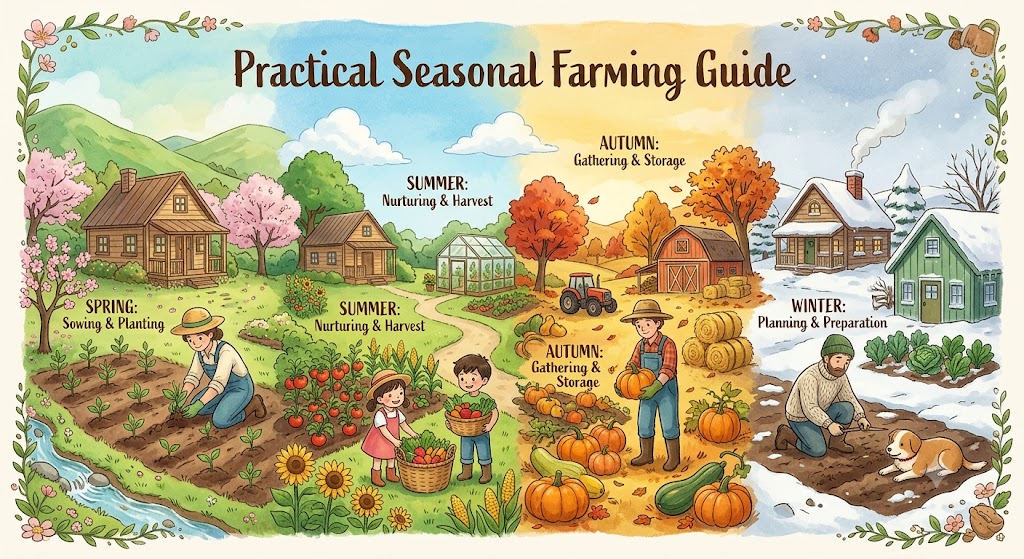
Winter provides an opportunity to review and prepare. Spring brings planting and early crop management. Summer focuses on growth, water, weeds, pests, and weather stress. Fall brings harvest and the first decisions for the following season.
The most valuable habit is to connect all of these periods together.
Every planting decision creates information for the next harvest. Every harvest creates information for the next planting season.
For farmers across the United States, the exact timing will always depend on location, crop, soil, climate, and farming system. But the principle remains the same: plan early, monitor regularly, record what happens, and use each season’s experience to make the next one better.
That mindset turns a farming calendar into something more useful than a list of dates—it becomes a practical management system for building a more organized, efficient, and resilient farm year after year.