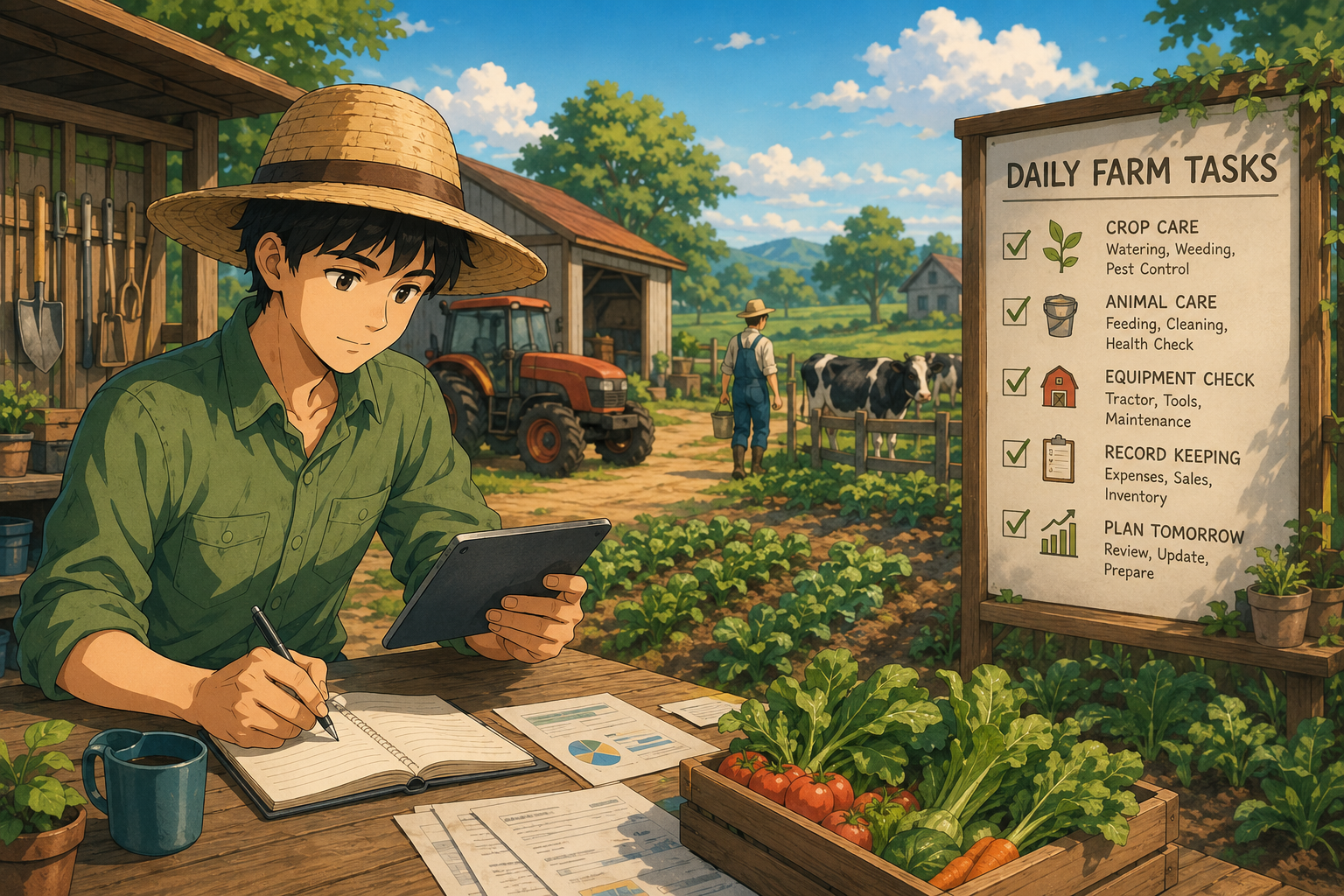
If you want to know what my first two years of farming looked like, picture a guy running in circles, holding a broken irrigation pipe in one hand and a half-empty bag of chicken feed in the other, constantly feeling like he was three days behind schedule.
When I started a decade ago, I thought farming was 90% agricultural knowledge and 10% hard work. I was dead wrong. I quickly learned that successful farming is actually 50% biology and 50% sheer, unapologetic logistics. You can have the best soil in the county, but if your daily operations are a chaotic mess, the farm will eventually break you.
Over the last ten years, I’ve had to completely rewire how I approach farm management. I stopped trying to work harder and finally learned how to work smarter.
To keep things fresh, I’m not just going to give you a list of theories. Instead, I am going to break down the Four-Pillar Management System I use every single day to keep my sanity intact and my farm turning a profit.
Pillar 1: The “Rule of Three” Task Triage
Farm work is infinite. There is a saying among old-timers: “The only time a farm is completely finished is when it’s sold.” If you wake up and look at a to-do list with 40 items on it, you are going to experience decision fatigue before you even put your boots on.
The Core Strategy: Every evening, I look at my master list and I extract exactly three non-negotiable tasks for the next day. Not ten. Not five. Three.
These are the tasks that directly impact the health of the farm or the bottom line. It might be:
- Fix the south pasture fence.
- Seed the winter greens.
- Call the tractor mechanic.
Everything else is background noise. If I get those three things done by noon, the day is a victory. If I have extra energy, I pull from the master list. But prioritizing just three heavy-hitting tasks keeps the needle moving forward without the crushing weight of an endless checklist.
The Rookie Mistake: Waking up and just tackling whatever happens to catch your eye first. The Veteran Fix: Ruthless prioritization the night before. You execute the plan; you don’t invent it on the fly.
Pillar 2: “Zone Management” for Daily Chores
I used to rack up 15,000 steps on my pedometer before 10 AM just walking back and forth across my acreage. I was losing hours of productive time simply transitioning between chores. Then, I borrowed a concept from permaculture design: Zoning.
The Core Strategy: Organize your physical farm layout and your daily schedule based on frequency of use.
- Zone 1 (High Frequency): This is the area immediately surrounding your house or main barn. Things that need daily or twice-daily attention—like the seedling greenhouse, the chicken coop, or the tool shed—must be located here.
- Zone 2 (Medium Frequency): The main market garden or the primary grazing pastures. You visit these once a day.
- Zone 3 (Low Frequency): Orchards, timber, or resting pastures. You only visit these weekly or monthly.
Once I physically moved my daily chores into a tight circle near the farmhouse, my morning routine dropped from two hours of frantic walking to 45 minutes of efficient, concentrated work.
The Rookie Mistake: Placing the chicken coop at the far end of the property because it “looks nice” out there. The Veteran Fix: Bring your most demanding daily tasks as close to your front door as physically possible.
Pillar 3: Modular “Go-Bags” and Tool Stations
Nothing drains farm morale faster than walking half a mile to fix a leaky water trough, only to realize you left the PVC primer back in the shed. I spent years bleeding time this way.
The Core Strategy: Stop storing your tools by type (all wrenches together, all pliers together). Start storing your tools by task.
I use cheap, heavy-duty 5-gallon buckets to create modular “Go-Bags” for specific farm systems.
- The Irrigation Bucket: Contains PVC glue, cutters, spare emitters, Teflon tape, and hose clamps.
- The Fencing Bucket: Holds a hammer, staples, wire cutters, tensioners, and spare insulators.
- The Harvest Bucket: Packed with clean harvest knives, rubber bands, a sharpening stone, and harvest tallies.
When a fence breaks, I don’t dig through a toolbox. I grab the Fencing Bucket and go. It guarantees I have exactly what I need, the first time.
The Rookie Mistake: Keeping one giant, disorganized toolbox in the main barn that you have to constantly return to. The Veteran Fix: Decentralized, task-specific tool kits ready to grab and go. Time is the only harvest you can’t grow more of—stop wasting it walking back for a wrench.
Pillar 4: The Low-Tech Command Center
We live in an era of farm management apps, digital spreadsheets, and cloud-based tracking. I’ve tried them all. You know what happens when you have mud on your hands, a glare from the sun, and 10% battery life? You stop using the app.
The Core Strategy: The heart of my farm is a massive, 4×6 foot dry-erase whiteboard bolted to the wall inside the main tool shed.
It is divided into simple quadrants:
- This Week’s Big 3 (The macro goals)
- Running Shopping List (Feed, hardware, seeds)
- Observation Notes (e.g., “Aphids spotted on East row,” “Tractor sounds rough on cold start”)
- The Master Task Backlog
It requires no passwords, no internet connection, and no clean hands. Anyone working on the farm can look at the board and instantly know the priorities for the week. It gets things out of my head and onto a physical space where I don’t have to stress about forgetting them.
The Rookie Mistake: Trying to keep the entire farm’s logistics organized in your head, or buried in a complex app you rarely open in the field. The Veteran Fix: A massive, unavoidable visual dashboard right where you put your boots on.
The 15-Minute Evening Walkabout
I will leave you with the most important management habit I’ve developed in ten years: The Evening Walkabout.
Every evening, just before the sun dips below the horizon, I leave my phone in the house and walk the property. I don’t carry any tools. I am not allowed to fix anything during this time.
I just observe.
I look at the soil moisture, I check the tension on the fences, and I look at the posture of the plants and the behavior of the animals. This 15-minute quiet observation is when I spot the small problems before they become disasters. It is also when I mentally write tomorrow’s “Rule of Three.”
Farming will always be hard work. But it doesn’t have to be chaotic work. By organizing your tasks, your tools, and your time, you stop merely surviving the season—and you finally start managing it.