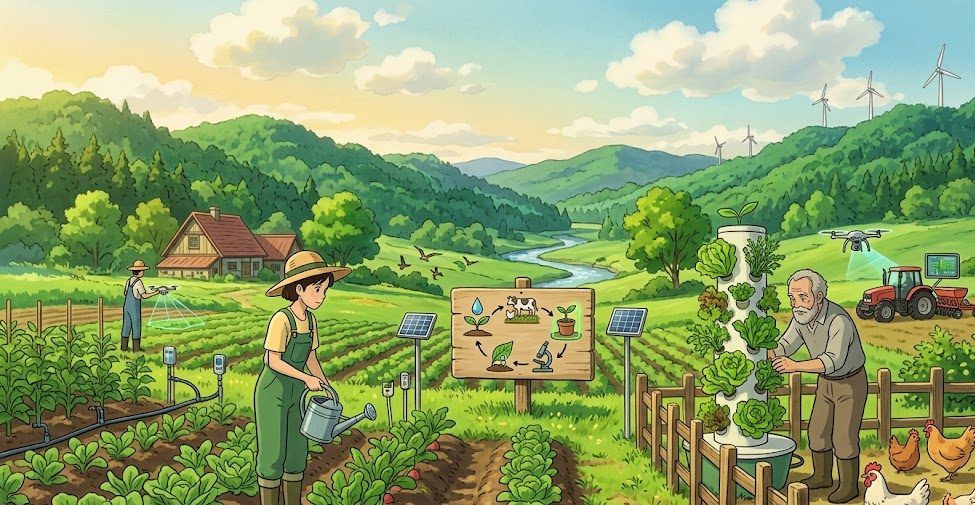
Agriculture is currently undergoing a massive transformation. The days of relying solely on guesswork and manual labor are being replaced by data-driven precision. Whether you are managing a small family plot or a larger commercial operation, the goal remains the same: how can we produce more food, more consistently, while using fewer resources?
The answer lies in “Smart Farming.” By integrating technology and data analytics into traditional agricultural practices, farmers can monitor their crops in real-time, react to environmental changes instantly, and predict outcomes with surprising accuracy. If you are looking to maximize your daily yield and ensure the longevity of your land, here are five proven smart farming techniques that are changing the game.
1. Precision Irrigation Systems
Water is the lifeblood of any farm, but inefficient watering is a leading cause of both crop loss and resource waste. Traditional irrigation often results in overwatering certain areas while leaving others parched.
How it works: Precision irrigation utilizes a network of soil moisture sensors placed strategically throughout your fields. These sensors measure the exact water content of the soil and send that data to a central controller. Instead of watering on a fixed timer, your irrigation system only activates when the soil moisture drops below a specific threshold.
The Benefits:
- Optimal Hydration: Crops receive the exact amount of water they need, preventing both water stress and root rot.
- Resource Conservation: You drastically reduce water usage, which is not only environmentally responsible but also lowers utility costs.
- Uniform Growth: By ensuring every section of your field receives consistent moisture, you eliminate patchy growth and ensure a more uniform harvest.
2. IoT-Based Crop Monitoring
The Internet of Things (IoT) has become an essential tool for the modern farmer. By placing connected sensors across your farm, you can monitor environmental conditions such as humidity, temperature, sunlight intensity, and soil pH levels without needing to be in the field physically.
How it works: You can set up low-cost IoT devices that sync with your smartphone or computer. These devices provide a live dashboard of your farm’s health. If the temperature in your greenhouse spikes or the soil acidity changes, you receive an instant alert.
Why it increases yield: The ability to respond in real-time to environmental changes is crucial. If you know a frost is coming or that your soil nutrients are depleting, you can take corrective action before the damage is done. This proactive approach prevents the “lag time” that usually results in crop mortality.
3. Automated Pest and Disease Detection
Pests and diseases are the silent killers of crop yield. By the time you notice visual damage on a plant, it is often too late to save that portion of your harvest.
How it works: Modern smart farms are using computer vision and drone technology to scan fields. High-resolution cameras capture images of your crops, and AI-powered software analyzes these images to spot early signs of distress—such as leaf discoloration, unusual spots, or pest infestations.
The Benefits:
- Targeted Treatment: Instead of spraying pesticides across the entire farm, you can identify the exact localized area that needs attention. This saves money on chemicals and prevents excess residue on your produce.
- Early Intervention: Detecting a disease at the first sign allows you to isolate the affected plants, preventing a full-scale outbreak.
4. Vertical Farming and Hydroponic Integration
If you are working with limited space, the traditional horizontal layout might be hindering your potential yield. Vertical farming allows you to stack layers of crops, effectively multiplying your growing space within the same physical footprint.
How it works: Combined with hydroponics (growing plants in nutrient-rich water rather than soil), vertical farming creates a controlled environment where light, water, and nutrients are perfectly balanced. Because these systems are usually enclosed, they are protected from weather extremes and pests.
The Result: You can grow year-round, regardless of the season. This “always-on” approach to farming means you are harvesting consistently every day, rather than waiting for specific growing seasons, which significantly increases your total annual output.
5. Data-Driven Crop Analytics
The most powerful tool in smart farming isn’t a machine—it’s the data you collect over time. By tracking planting dates, harvest weights, weather patterns, and nutrient inputs, you can build a historical database of what works best for your specific soil and climate.
How it works: Using simple spreadsheets or dedicated farm management software, record every action taken on your farm. After a few cycles, you will start to see patterns. You might discover, for instance, that a certain variety of tomato yields 15% more when planted two weeks earlier than you previously thought.
Turning Data into Yield: When you make decisions based on historical performance rather than intuition, you eliminate the “hit-or-miss” factor. You are essentially refining your process with every harvest, slowly but surely squeezing more productivity out of every square foot of land.
Frequently Asked Questions (FAQs)
Q: Do I need a massive budget to start smart farming? A: Not at all. You can start small with a few affordable soil moisture sensors or by simply digitizing your record-keeping. Technology should be implemented as your budget and farm size allow.
Q: Is smart farming only for large-scale commercial farms? A: Absolutely not. Many IoT and automation tools are designed specifically for smallholders and hobbyist farmers looking to improve their efficiency.
Q: Will technology replace the need for farmers? A: Never. Smart farming is a tool designed to support the farmer, not replace them. It handles the data collection and monitoring so you can focus on high-level management and decision-making.
Q: How long does it take to see an increase in yield? A: Depending on the technique, you may see improvements within a single growing season, especially with better irrigation and monitoring practices.
Conclusion
Increasing your daily crop yield isn’t about working harder; it’s about working smarter. By integrating these five techniques—precision irrigation, IoT monitoring, automated pest detection, vertical systems, and data analytics—you can transition from traditional, unpredictable methods to a stable, high-performance farming model.
Start small, choose one technique that addresses your biggest bottleneck, and watch how technology turns your farm into a more productive and profitable venture. The future of agriculture is here, and it is more accessible than ever before.