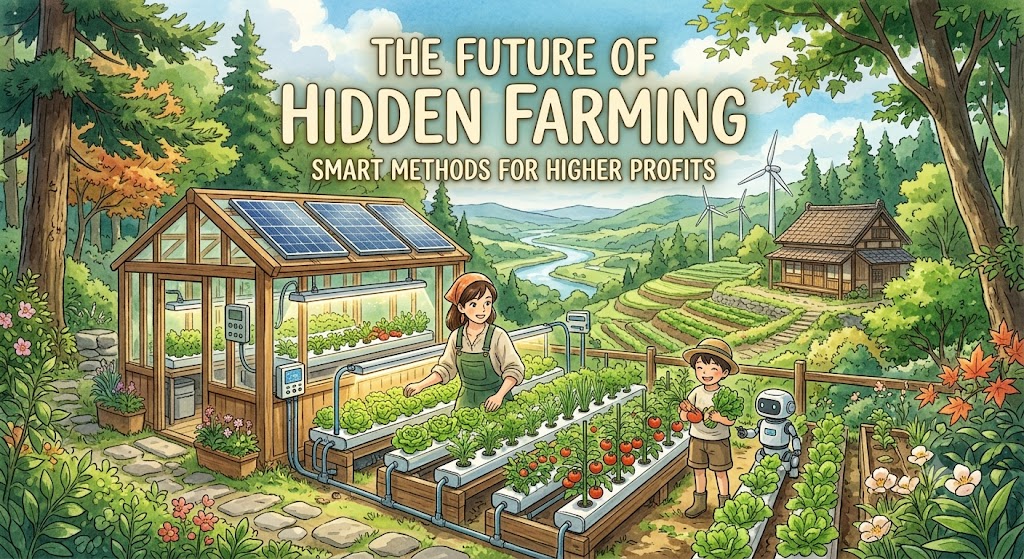
Modern agriculture is entering a new era where success is no longer measured by how much land a farmer owns. Instead, profits increasingly depend on how efficiently resources are managed, how quickly problems are identified, and how well natural farming practices are combined with modern technology.
Hidden farming is becoming one of the most promising approaches for the future. It focuses on improving productivity through smarter decisions rather than simply increasing the use of fertilizers, pesticides, or expensive equipment. Farmers who embrace these methods are discovering that higher profits often come from reducing waste, protecting soil health, and making every square meter of farmland more productive.
Why Traditional Farming Alone Is No Longer Enough
Agriculture today faces several growing challenges.
- Rising production costs
- Unpredictable weather
- Water shortages
- Declining soil fertility
- Increasing pest resistance
- Higher labor expenses
These challenges mean that repeating old farming practices without improvement can gradually reduce profitability.
Future-ready farmers are adopting hidden techniques that help them produce more while spending less.
The New Generation of Smart Farming
Smart farming is not limited to large commercial farms with expensive machines.
Even small-scale farmers can benefit from simple innovations such as:
| Smart Practice | Main Benefit |
|---|---|
| Soil moisture monitoring | Saves irrigation water |
| Organic mulching | Reduces evaporation |
| Crop rotation | Restores soil fertility |
| Precision fertilizer application | Reduces input costs |
| Weather planning | Prevents unnecessary losses |
| Farm record keeping | Improves future decisions |
Many of these practices require more observation than investment.
Turning Farm Data Into Better Decisions
One of the biggest changes in modern agriculture is the use of information.
Successful farmers now monitor:
- Rainfall patterns
- Soil moisture
- Crop growth
- Pest activity
- Market prices
- Harvest timing
Keeping track of this information allows farmers to make informed decisions instead of relying only on experience or guesswork.
Even a simple notebook or smartphone can become a powerful farm management tool.
Healthy Soil Will Become the Greatest Asset
Future farming will focus more on building soil than feeding crops.
Rich soil naturally provides:
- Better nutrient availability
- Stronger root development
- Improved water retention
- Increased microbial activity
- Higher resistance to drought
Instead of depending entirely on chemical fertilizers, many farmers are investing in compost, cover crops, crop residues, and organic amendments that improve productivity year after year.
Healthy soil creates long-term profits rather than short-term gains.
Natural Pest Control Is Gaining Importance
Overusing pesticides often increases farming costs while creating resistant insect populations.
The future of hidden farming encourages balanced pest management through:
- Beneficial insects
- Bird-friendly environments
- Crop diversity
- Companion planting
- Trap crops
- Regular field monitoring
These practices reduce chemical dependency while maintaining healthy crop production.
Water Efficiency Will Define Future Success
Water is becoming one of agriculture’s most valuable resources.
Farmers who improve irrigation efficiency are likely to remain more profitable.
Effective strategies include:
- Drip irrigation
- Rainwater harvesting
- Mulching
- Deep watering
- Irrigation scheduling
Saving water not only reduces expenses but also protects crops during dry seasons.
Diversification Creates Financial Stability
Depending on a single crop increases financial risk.
Future-focused farms are becoming more diversified by combining different agricultural activities.
Examples include:
- Vegetables with fruit trees
- Poultry with crop farming
- Fish farming with irrigation ponds
- Beekeeping alongside orchards
- Medicinal plants with traditional crops
Diversification creates multiple income sources and reduces the impact of market fluctuations.
Technology Supports Better Farming Decisions
Modern technology is becoming easier and more affordable.
Farmers increasingly use tools such as:
- Mobile farming applications
- Weather forecasting services
- Satellite crop monitoring
- GPS field mapping
- Automated irrigation systems
These technologies help farmers respond quickly to changing conditions while improving efficiency.
Importantly, technology works best when combined with strong farming knowledge rather than replacing it.
Waste Can Become a Valuable Resource
Future farming emphasizes recycling materials already available on the farm.
Examples include:
- Crop residues converted into compost
- Animal manure used as organic fertilizer
- Rainwater collected for irrigation
- Plant waste used as mulch
- Kitchen waste transformed into compost
Reducing waste lowers production costs while improving environmental sustainability.
Farmers Must Continue Learning
Agriculture continues to evolve every year.
New crop varieties, changing climates, and improved farming methods require continuous learning.
Successful farmers regularly:
- Attend agricultural workshops
- Learn from neighboring farmers
- Test new techniques on small plots
- Follow seasonal recommendations
- Review previous harvest records
Continuous improvement often provides greater profits than expanding farmland.
Future Farming Success Checklist
Before every growing season, future-ready farmers should ask themselves:
✔ Is the soil healthier than last year?
✔ Can irrigation be improved?
✔ Are crop choices suitable for current market demand?
✔ Can organic materials replace some chemical inputs?
✔ Is pest monitoring planned?
✔ Have previous farming records been reviewed?
✔ Can farm waste be reused?
✔ Is there an opportunity to diversify income?
These simple questions help build a stronger and more profitable farming system.
What Beginners Should Focus On
Instead of trying every modern farming method at once, beginners should gradually improve one area at a time.
A practical order is:
- Improve soil health.
- Learn efficient irrigation.
- Maintain farm records.
- Practice crop rotation.
- Introduce organic matter.
- Monitor pests regularly.
- Diversify production.
- Adopt simple technologies.
This step-by-step approach makes farming improvements easier to manage and more sustainable.
Final Thoughts
The future of hidden farming is not about replacing traditional agriculture—it is about improving it with smarter, more efficient methods. Farmers who focus on soil health, resource conservation, diversified production, and informed decision-making are likely to achieve higher profits while protecting their land for future generations.
Success in tomorrow’s agriculture will belong to those who understand that every drop of water, every handful of soil, and every farming decision has long-term value. By combining natural practices with practical innovation, farmers can build resilient farms that remain productive, profitable, and environmentally sustainable for many years to come.
Frequently Asked Questions
1. What is hidden farming?
Hidden farming refers to lesser-known practices that improve productivity through better soil management, efficient resource use, natural pest control, and smarter farming decisions.
2. Can small farmers benefit from smart farming methods?
Yes. Many smart farming techniques require planning and observation rather than expensive equipment, making them suitable for farms of all sizes.
3. Why is soil health considered the future of farming?
Healthy soil supports stronger plant growth, improves water retention, increases nutrient availability, and reduces dependence on synthetic fertilizers.
4. Does technology replace traditional farming knowledge?
No. Technology provides useful information, but successful farming still depends on practical experience and good management decisions.
5. Which smart farming practice offers the best return?
Improving soil health, conserving water, and maintaining accurate farm records are among the most cost-effective methods for increasing long-term farm profits.