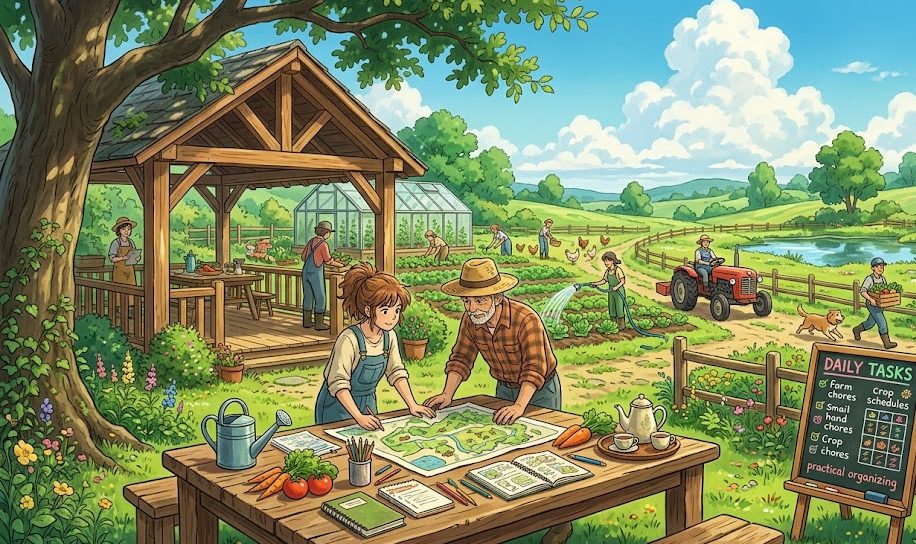
Running a farm involves hundreds of small activities. Checking crops, managing irrigation, removing weeds, feeding livestock, inspecting equipment, recording expenses, preparing harvested produce, and coordinating workers can quickly become difficult when everything is handled without a clear routine.
Farm session planning provides a practical way to organize these activities into manageable work periods. Instead of approaching farm work as one long list of unfinished tasks, farmers can divide the day into focused sessions based on urgency, crop requirements, weather, available labor, and seasonal priorities.
A farm session can be as short as a focused inspection or as long as a few hours of coordinated field work. The important idea is to give each work period a clear purpose.
Good session planning does not mean every minute of the day must be scheduled. Agriculture is affected by weather, crop conditions, equipment problems, and unexpected events. A useful plan therefore needs structure while leaving enough flexibility to respond to real conditions.
1. What Is Farm Session Planning?
Farm session planning is the process of organizing farm activities into specific work periods.
Instead of writing a large list such as “take care of the farm,” a farmer can divide responsibilities into practical sessions.
For example:
Morning session: field inspection and irrigation checks.
Crop-care session: weed management, pruning, or plant inspection.
Maintenance session: tools, machinery, fencing, or irrigation equipment.
Harvest session: picking, sorting, and preparation.
Record session: expenses, crop observations, inventory, and planning.
The exact structure depends on the type of farm.
The goal is simple: every work period should have a clear objective.
2. Begin With the Most Important Tasks
Not every farm task has the same priority.
Some activities directly affect crop health and should be completed quickly. Others can safely wait.
A useful priority system can divide tasks into three groups.
Immediate tasks: irrigation problems, damaged crops, livestock concerns, equipment failures, or urgent weather preparation.
Scheduled tasks: weeding, fertilizing, pruning, routine inspection, maintenance, and harvesting.
Flexible tasks: cleaning storage areas, reorganizing tools, updating records, and other activities that can be moved if necessary.
This prevents less important work from taking attention away from urgent agricultural needs.
3. Build a Daily Farm Routine
A consistent daily routine makes farm management easier.
A simple routine might begin with a general observation of the property.
Check the weather, walk through important crop areas, inspect irrigation, and look for unusual changes.
After the initial inspection, move into the day’s highest-priority work.
Later sessions can focus on routine crop care, maintenance, harvesting, or administrative work.
The routine should not become rigid.
If heavy rain is expected, outdoor tasks may need to be moved. If a crop suddenly requires attention, planned work may need to change.
The routine provides direction, not a restriction.
4. Use the First Session for Observation
The beginning of the working day is a useful time for observation.
Walk through the field and look for changes that may have occurred since the previous inspection.
Check plant appearance, soil moisture, irrigation equipment, signs of pests, damaged structures, and other important areas.
Early observation can identify problems before they become larger.
For example, a small irrigation leak may be easy to repair, while an unnoticed leak can create water loss or uneven crop growth over several days.
The first session should therefore focus on understanding what the farm needs that day.
5. Group Similar Tasks Together
Efficiency improves when similar activities are performed together.
If several crops need inspection, organize the inspection into one field session rather than repeatedly walking between the same areas.
If multiple tools need cleaning, complete the work together.
If several irrigation points need checking, inspect them during one dedicated session.
Grouping tasks reduces unnecessary movement and helps farmers maintain concentration.
This approach can be particularly useful on larger farms where travel between different sections consumes significant time.
6. Create Crop-Specific Sessions
Different crops may require different forms of attention.
A vegetable plot may need frequent harvesting and weed control.
An orchard may require pruning, tree inspection, irrigation, or fruit monitoring.
A grain crop may require less daily manual attention but still needs periodic checks for moisture, weeds, pests, and disease.
Instead of giving every crop the same amount of attention, farmers can create crop-specific sessions based on actual requirements.
This avoids wasting time on areas that do not need intensive management.
7. Schedule Irrigation Carefully
Irrigation can become one of the most repetitive farm activities, making it important to organize efficiently.
Farmers should know which areas require water, which irrigation method is being used, and which sections need inspection.
A session can begin by checking the water source and equipment before moving through the irrigation zones.
Record unusual problems such as low pressure, blocked outlets, leaks, or areas receiving too much or too little water.
Irrigation planning should also consider rainfall and current soil moisture.
A fixed routine is useful, but actual field conditions should always influence the final decision.
8. Plan Weed Management in Short Sessions
Weed control can become overwhelming when postponed for too long.
Instead of waiting until weeds cover large areas, farmers can schedule regular short sessions.
Divide the farm into sections and work through them systematically.
This makes the task easier to manage and reduces the amount of heavy work required at one time.
The best weed-management method depends on the crop, weed species, field size, soil conditions, and available labor.
The important planning principle is consistency.
9. Schedule Crop Monitoring
Crop monitoring should be treated as a planned activity rather than something done only when a problem becomes visible.
During monitoring sessions, examine leaves, stems, flowers, fruits, soil conditions, and overall plant development.
Look for unusual changes such as discoloration, wilting, insect activity, physical damage, or uneven growth.
Farmers can divide fields into inspection zones and record observations.
This creates a useful history of crop development and makes it easier to identify recurring problems.
10. Plan Fertility and Soil-Care Activities
Fertilizer applications, compost use, soil amendments, and other fertility activities should be scheduled according to crop requirements and the overall production plan.
Avoid treating these tasks as emergency activities.
Keep materials organized and record when they were applied.
Where soil testing or professional agricultural guidance is available, use that information to support fertility decisions.
A well-planned soil-care session can also include checking erosion, drainage, compaction, organic matter management, and other long-term soil conditions.
11. Create a Harvest Session
Harvesting should have its own organized workflow.
Before entering the field, prepare containers, tools, transportation, storage space, and labor.
Harvest products according to appropriate maturity standards for the crop.
After harvesting, move products quickly into the next stage, such as sorting, grading, cooling, drying, packaging, or transportation.
Separating harvesting from unrelated farm activities can improve focus and reduce product damage.
It also makes it easier to estimate how much labor is required for future harvest sessions.
12. Give Post-Harvest Work Its Own Time
A common mistake is to consider the day’s farm work finished after harvesting.
Harvested crops still need attention.
Sorting, cleaning, grading, packaging, storage, and transportation can influence the final value of the product.
A dedicated post-harvest session ensures these activities are not forgotten.
The exact process depends on the crop.
Some products require rapid handling, while others can be stored or processed over a longer period.
Understanding these differences helps farmers create realistic daily schedules.
13. Include Equipment Maintenance Sessions
Farm equipment should not be maintained only after it breaks.
Regular maintenance sessions can include checking irrigation components, cleaning tools, inspecting machinery, tightening loose parts, checking storage areas, and organizing supplies.
Small maintenance tasks can be combined into a regular weekly session.
More detailed maintenance can be scheduled before major planting or harvesting periods.
This reduces the likelihood of equipment becoming unavailable when it is needed most.
14. Manage Farm Inventory
Farmers need to know what supplies are available.
Inventory can include seeds, fertilizer, compost materials, containers, tools, irrigation parts, protective equipment, packaging supplies, and other inputs.
A short inventory session each week or at another suitable interval can identify materials that are running low.
This makes purchasing more organized.
It also reduces the risk of discovering an empty supply container in the middle of an important farm activity.
15. Coordinate Workers With Clear Assignments
When several people work on a farm, unclear responsibilities can create duplicated work or neglected tasks.
At the beginning of a work session, each person should understand the task, location, expected result, and any important safety requirements.
For example:
Worker A: inspect irrigation lines.
Worker B: remove weeds from Section Two.
Worker C: harvest mature produce from Section Four.
Clear assignments make it easier to measure progress.
At the end of the session, workers can report completed tasks and problems that need attention.
16. Use Time Blocks Instead of Constant Switching
Moving from one unrelated task to another can reduce efficiency.
Time-blocking allows farmers to concentrate on one category of work for a defined period.
For example:
Inspection block → crop-care block → maintenance block → harvest block → records block
The length of each block can vary.
The important principle is to avoid unnecessary switching.
Farm work will always contain interruptions, but a basic time-block structure can keep the day organized.
17. Plan Around Weather
Weather should be part of the daily schedule.
Check expected conditions before deciding which activities should be performed first.
Dry weather may provide a useful opportunity for certain field operations, while rain may make some activities impractical.
Extremely hot conditions may also influence when outdoor work should be performed.
Some tasks can be moved to cooler parts of the day, while indoor work such as record keeping, sorting, equipment organization, or planning can be performed when field conditions are less suitable.
Flexible scheduling helps protect both productivity and worker safety.
18. Leave Space for Unexpected Problems
A farm schedule should never be completely full.
Leave some time available for unexpected issues.
An irrigation pump may fail. A storm may damage plants. A livestock enclosure may require repair. A crop may show an unusual problem.
If every minute is already assigned, unexpected work can disrupt the entire day.
A flexible schedule provides room to respond without abandoning important tasks.
19. Use a Simple Daily Farm Sheet
Farmers do not need complicated software to organize sessions.
A basic daily sheet can contain:
Date
Weather
Main priority
Field or farm section
Task
Assigned person
Start time
Completion status
Problem observed
Follow-up required
This information can be written on paper, a spreadsheet, or a digital farm-management system.
The important part is consistency.
20. Review the Day Before Finishing
A short end-of-day review can improve the following day’s plan.
Ask:
What was completed?
What remains unfinished?
What problems were discovered?
What needs urgent attention tomorrow?
Are any supplies running low?
Will weather change tomorrow’s schedule?
Which tasks should be moved?
This review can take only a few minutes but can prevent confusion the next morning.
21. Create Weekly Farm Sessions
Daily planning handles immediate work, while weekly planning handles larger responsibilities.
A weekly review can include:
Crop development
Irrigation performance
Pest observations
Weed pressure
Equipment condition
Labor requirements
Inventory
Upcoming harvests
Market commitments
The weekly plan can then be converted into daily sessions.
This creates a connection between long-term goals and everyday work.
22. Separate Routine Work From Improvement Work
Routine work keeps the farm operating.
Improvement work makes the farm better.
For example, daily irrigation inspection is routine.
Redesigning an inefficient irrigation layout is improvement work.
Daily weed removal is routine.
Testing a better weed-management method is improvement work.
Farmers should reserve some time for improvements instead of spending every day reacting to immediate tasks.
Small improvements can produce significant benefits over an entire season.
23. Track Which Tasks Consume the Most Time
Farm session planning also creates an opportunity to understand where time is being spent.
Record how long major activities take.
If irrigation consistently consumes several hours, there may be opportunities to improve the system.
If harvesting requires more labor than expected, planting schedules or crop selection may need adjustment.
If workers spend excessive time searching for tools, storage organization may need improvement.
Time records turn vague frustrations into measurable problems.
24. Build a Repeatable Farm System
The ultimate goal of farm session planning is to create a system that can be repeated.
A useful cycle looks like this:
Observe → Prioritize → Assign → Work → Record → Review → Improve
Observation shows what the farm needs.
Prioritization determines what matters most.
Assignment gives responsibilities to people or work sessions.
The work is then completed.
Records capture what happened.
Review identifies unfinished tasks and problems.
Improvement makes the next cycle more efficient.
This system can be adapted to almost any type of farm.
Final Thoughts
Farm work can become difficult when every activity is handled as an isolated task. A clear session-based approach creates structure without removing flexibility.
Farm session planning helps farmers organize crop inspections, irrigation, weed control, soil care, harvesting, equipment maintenance, inventory, worker assignments, and record keeping into manageable periods.
The key is not to create a perfect schedule that never changes.
The goal is to create a practical framework that answers three simple questions:
What needs to be done?
When should it be done?
Who or what is responsible for doing it?
Once these questions are answered, everyday farm work becomes easier to coordinate.
A strong system also leaves room for weather changes and unexpected problems. It separates urgent work from routine activities, groups similar tasks together, and creates time for long-term improvements.
Over time, farm session planning can reveal where labor, water, equipment, and time are being wasted. Those observations can then be used to improve the farm itself.
In the end, efficient farming is not simply about working harder. It is about organizing work more intelligently.
A well-planned farm day allows farmers to spend less time deciding what to do next and more time completing the activities that actually matter for crop health, farm productivity, and long-term agricultural success.