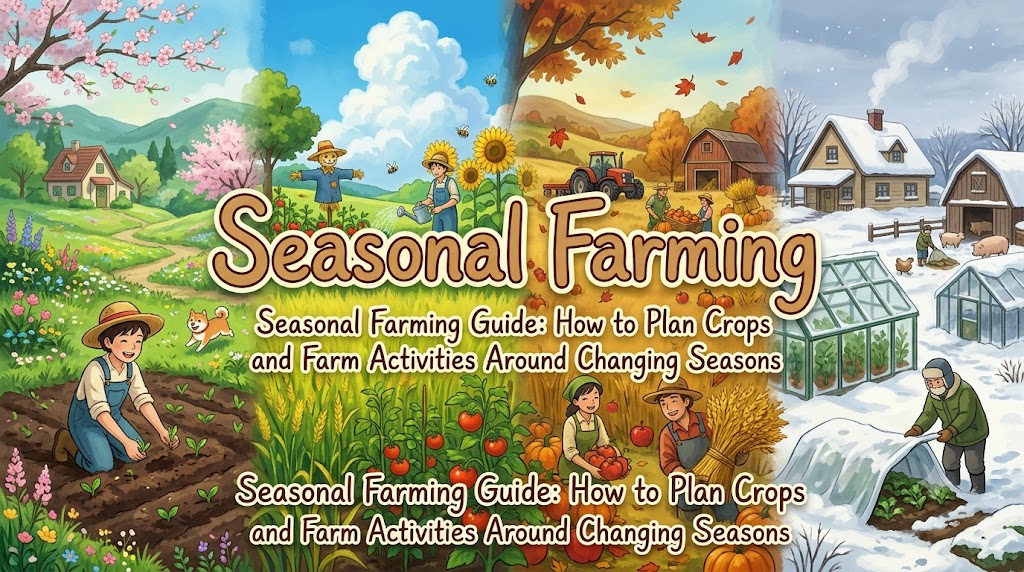
Farming is closely connected to the changing seasons. Temperature, rainfall, daylight, soil moisture, wind, and humidity can all influence how crops grow and how agricultural work should be organized. A crop that performs well during one part of the year may struggle when planted under completely different conditions.
For this reason, successful crop production requires more than simply choosing good seeds. Farmers need to understand the seasonal cycle and adjust their planting, irrigation, soil preparation, crop protection, harvesting, and other activities accordingly.
Seasonal farming is the practice of organizing agricultural activities around predictable changes in weather and growing conditions. It helps farmers make better use of available land, water, labor, and time.
A seasonal plan does not have to be complicated. Even a simple calendar showing when to prepare the field, plant crops, monitor growth, irrigate, harvest, and prepare for the next season can make farm management more organized.
1. Understand Your Local Growing Seasons
The first step in seasonal farming is understanding the climate of the area where the farm is located.
Different regions experience different combinations of heat, cold, rainfall, humidity, and dry periods. Even within the same country, agricultural calendars can vary significantly.
Farmers should observe local patterns rather than depending entirely on a generic seasonal calendar.
Important observations include:
When temperatures begin rising
When rainfall normally starts
When the wet period becomes strongest
When temperatures begin falling
When frost or cold conditions may occur
When dry periods normally appear
Historical weather records, local agricultural information, and personal farm records can all help identify these patterns.
2. Create a Seasonal Farm Calendar
A seasonal calendar provides a simple overview of the year.
Instead of thinking about farming as one continuous activity, divide the year into planning periods.
A basic calendar can include:
Pre-season: crop selection, soil preparation, equipment checks, seed purchasing.
Planting period: sowing, transplanting, irrigation setup, early weed control.
Growing period: crop monitoring, irrigation, fertility management, pest observation.
Harvest period: maturity checks, harvesting, sorting, storage, and transportation.
Post-harvest period: field cleanup, residue management, soil improvement, and planning for the next crop.
The exact timing depends on local climate and crop selection.
3. Choose Crops According to the Season
Crop selection should match the conditions expected during the growing period.
Some crops perform better during cooler weather, while others require warm temperatures. Some tolerate wetter conditions, while others perform better when excessive moisture is avoided.
Farmers should consider the entire growing period rather than only the planting date.
A crop planted at the beginning of a favorable season may reach maturity during a completely different weather period.
Therefore, ask:
What conditions does the crop need during germination?
What temperatures support vegetative growth?
How much moisture is required?
What weather is expected near harvest?
Will extreme heat, heavy rain, or cold arrive during a sensitive growth stage?
These questions help create a more realistic crop plan.
4. Prepare Soil Before the Season Begins
Soil preparation should be completed before planting becomes urgent.
Depending on the farming system, preparation may involve improving drainage, managing crop residues, adding suitable organic material, preparing beds, checking soil condition, or correcting known nutrient limitations.
The objective is to create a suitable environment for roots.
Seasonal soil preparation also provides an opportunity to inspect the field for problems that may become more serious later.
Poor drainage, compacted areas, erosion, and uneven field levels are easier to address before crops occupy the land.
5. Spring and Mild-Weather Planning
In regions with a distinct spring period, moderate temperatures can create favorable conditions for many crops.
This period can be used for establishing suitable vegetables, herbs, flowers, grains, or other seasonal crops depending on local conditions.
Farmers should pay attention to temperature changes rather than assuming that the entire season will remain mild.
Early-season planting can sometimes be affected by unexpected cold, while later planting may face increasing heat.
This makes planting timing an important part of seasonal planning.
6. Summer Farming Requires Heat Management
Warm seasons can increase evaporation and water demand.
Plants may experience heat stress when temperatures become high, particularly if irrigation is inadequate or soil moisture changes rapidly.
Farmers can prepare by improving irrigation efficiency, maintaining appropriate soil moisture, using suitable mulch, providing shade where appropriate, and selecting crops that can tolerate expected conditions.
Water should be monitored carefully.
Overwatering is not a replacement for good heat management. Excess moisture can create other problems, particularly where drainage is poor.
7. Rainy-Season Farming Needs Drainage Planning
Rainfall can provide valuable water for crops, but excessive moisture can create serious agricultural challenges.
Heavy rainfall can cause waterlogging, erosion, nutrient movement, plant damage, and difficult field access.
Drainage should therefore be considered before the rainy period begins.
Farmers can inspect drainage channels, field slopes, low-lying areas, and water-collection points.
Raised beds or other field arrangements may be useful for suitable crops.
The key is to make sure that rainfall becomes a resource rather than a source of unnecessary crop stress.
8. Winter and Cool-Weather Farming
Cooler seasons can support crops that prefer lower temperatures, depending on the region.
However, winter farming also requires attention to cold nights, reduced evaporation, shorter daylight periods, and potential frost in suitable climates.
Irrigation schedules may need adjustment because water loss can differ from warmer periods.
Farmers should also monitor crops for slower growth and consider whether planting dates provide enough time for the crop to mature before temperatures change again.
9. Adjust Irrigation Throughout the Year
Water requirements are not fixed.
A crop may require more frequent irrigation during hot and dry weather and less during periods of rainfall or cooler temperatures.
Soil type also matters.
Sandy soils may lose available moisture more quickly, while heavier soils may retain water longer.
Instead of using exactly the same irrigation schedule throughout the year, farmers should observe soil moisture, plant condition, rainfall, temperature, and crop growth.
Seasonal irrigation planning can improve both water efficiency and crop health.
10. Manage Soil Moisture With Mulch
Mulching can be useful in several seasons.
Organic or suitable surface materials can help reduce evaporation, protect soil from direct weather exposure, reduce erosion, and suppress some weeds.
During hot periods, mulch can help slow moisture loss.
During heavy rainfall, suitable ground cover can help protect the soil surface from erosion.
However, mulch should be managed according to the crop and local conditions.
Too much moisture around plant stems or poorly managed organic material can create other problems.
11. Adjust Fertility Management
Crop nutrient requirements change as plants move through different growth stages.
Seasonal conditions can also affect nutrient availability.
For example, heavy rainfall can influence nutrient movement through the soil, while dry conditions can affect how easily plant roots access available nutrients.
Farmers should avoid applying nutrients simply because the calendar says it is time.
Instead, applications should be based on crop requirements, soil information, previous field performance, and appropriate agricultural guidance.
A seasonal fertility plan can prevent unnecessary input use while supporting crop development.
12. Prepare for Seasonal Pest Changes
Pest activity can change throughout the year.
Certain insects may become more active during warm periods, while others may appear under particular combinations of moisture and temperature.
Diseases can also become more likely when environmental conditions favor their development.
Regular crop monitoring is therefore important.
Farmers should observe leaves, stems, flowers, fruits, and the surrounding soil.
Early detection can provide more options for management.
The goal is not to react to every insect or unusual mark but to correctly identify whether a genuine crop problem is developing.
13. Plan Labor Around Seasonal Workloads
Labor requirements can change dramatically throughout the year.
Planting, weeding, pruning, and harvesting may create short periods when many workers are needed simultaneously.
Farmers should identify these high-demand periods before they arrive.
A seasonal labor plan can include:
Field preparation
Planting
Irrigation management
Weed control
Crop monitoring
Harvesting
Sorting and packing
Post-harvest cleanup
Planning early can prevent delays during critical crop stages.
14. Maintain Equipment Before Busy Periods
Equipment failures become especially inconvenient during planting and harvesting.
Before a major seasonal activity begins, inspect tools, pumps, irrigation systems, machinery, storage areas, containers, and other essential equipment.
Check for worn parts, leaks, damaged connections, and other obvious problems.
Preventive maintenance is generally easier when equipment is not urgently needed.
A few hours spent preparing equipment before the season can prevent much larger disruptions later.
15. Use Staggered Planting
Planting an entire crop on one day can create a concentrated workload and concentrated harvest.
Where appropriate, staggered planting can spread production across a longer period.
This may make labor management easier and reduce the pressure of handling a very large harvest at once.
It can also provide more flexibility when weather conditions change.
However, staggered planting should be used only when suitable for the crop and local growing conditions.
16. Plan Harvest Around the Season
Harvest timing should account for both crop maturity and expected weather.
A crop approaching maturity during a period of heavy rainfall may require different planning than one harvested during dry conditions.
Farmers should monitor maturity closely and prepare labor, containers, transportation, and storage in advance.
Harvesting should not become an emergency activity.
A well-planned harvest protects both crop quality and farm efficiency.
17. Protect Harvested Crops From Weather
Seasonal conditions continue to matter after the crop leaves the field.
Hot temperatures can accelerate quality loss in certain products. Humidity can affect storage. Rain can create difficulties for outdoor drying or transportation.
Farmers should therefore consider post-harvest conditions when selecting harvest dates and storage methods.
Depending on the crop, suitable practices may include shade, ventilation, drying, cooling, grading, protected storage, or rapid transportation.
18. Use Crop Rotation Across Seasons
Seasonal planning becomes more powerful when several seasons are considered together.
Instead of planning only the next crop, farmers can design a sequence of crops across the year.
A rotation can help distribute labor, manage soil fertility, reduce repeated pest pressure, and make better use of available growing conditions.
For example, one crop may be followed by another with different nutrient requirements or a different root structure.
The rotation should be designed according to local climate, crop families, soil conditions, and market opportunities.
19. Keep a Seasonal Farm Diary
A farm diary can become one of the most useful planning tools.
Record:
Planting dates
Rainfall observations
Irrigation dates
Pest appearances
Disease problems
Fertilizer applications
Harvest dates
Harvest quantities
Selling prices
Weather-related damage
Labor challenges
At the end of the year, these records provide a valuable history of how the farm responded to different conditions.
Over several seasons, patterns become easier to recognize.
20. Build a Flexible Plan
A seasonal calendar is a guide, not a guarantee.
Weather can change unexpectedly. Rain may arrive early or late. Temperatures may remain high longer than expected. A pest problem may appear earlier than usual.
For this reason, farmers should avoid creating plans that cannot be adjusted.
A good seasonal plan contains alternative options.
If rainfall is delayed, what changes?
If heavy rainfall occurs, what needs to be protected?
If a crop cannot be planted on time, what alternative crop is suitable?
If the harvest is delayed, how will storage be handled?
Thinking about these possibilities before the season begins improves preparedness.
21. Divide the Farm Into Management Zones
Larger farms may not have identical conditions across the entire property.
One section may have better drainage, while another may remain wet.
One area may receive more sunlight, while another may be affected by shade.
Dividing the farm into management zones allows farmers to make more precise decisions.
Different zones can have different irrigation schedules, crop choices, soil-management practices, or monitoring priorities.
Even small farms can benefit from recognizing these differences.
22. Make Seasonal Decisions Based on Results
At the end of each season, compare expectations with actual results.
Ask:
Which crops performed best?
Which crops struggled?
Was irrigation sufficient?
Was labor available when needed?
Did weather cause unexpected problems?
Were input costs higher than expected?
Was the harvest easy to sell?
Did storage work effectively?
The answers can improve next year’s plan.
Seasonal farming becomes more efficient when each season provides information for the next one.
23. Create a Simple Year-Round Workflow
A practical year-round farming system can follow a repeating cycle:
Observe → Plan → Prepare → Plant → Monitor → Adjust → Harvest → Review
Observation identifies local conditions.
Planning determines what should be grown.
Preparation creates the right starting environment.
Planting begins production.
Monitoring identifies problems.
Adjustment keeps the crop on track.
Harvest captures the result.
Review turns experience into knowledge.
Repeating this cycle helps create a more organized farm.
Final Thoughts
Seasonal farming is about working with changing environmental conditions instead of treating every part of the year the same way.
Temperature, rainfall, soil moisture, daylight, pests, labor availability, and market conditions can all change throughout the year. Farmers who recognize these changes can make better decisions about crop selection, planting dates, irrigation, soil preparation, crop protection, harvesting, and post-harvest handling.
The most useful seasonal plan is not necessarily the most complicated one. A simple calendar combined with good field observation can provide a strong foundation.
Farmers can begin by recording local weather patterns, identifying suitable crops for different periods, preparing soil and equipment before busy seasons, adjusting irrigation according to conditions, monitoring crops regularly, and reviewing results after every harvest.
The biggest advantage of seasonal planning is preparation.
Instead of asking what to do only after a problem appears, farmers can anticipate important activities before they become urgent.
A well-organized seasonal farming system therefore becomes a continuous cycle of planning and improvement. Each season provides new information, and each year gives farmers an opportunity to refine their methods.
By matching crops and farm activities with changing seasons, farmers can make better use of land, water, labor, time, and other resources while creating a more organized and adaptable agricultural operation.