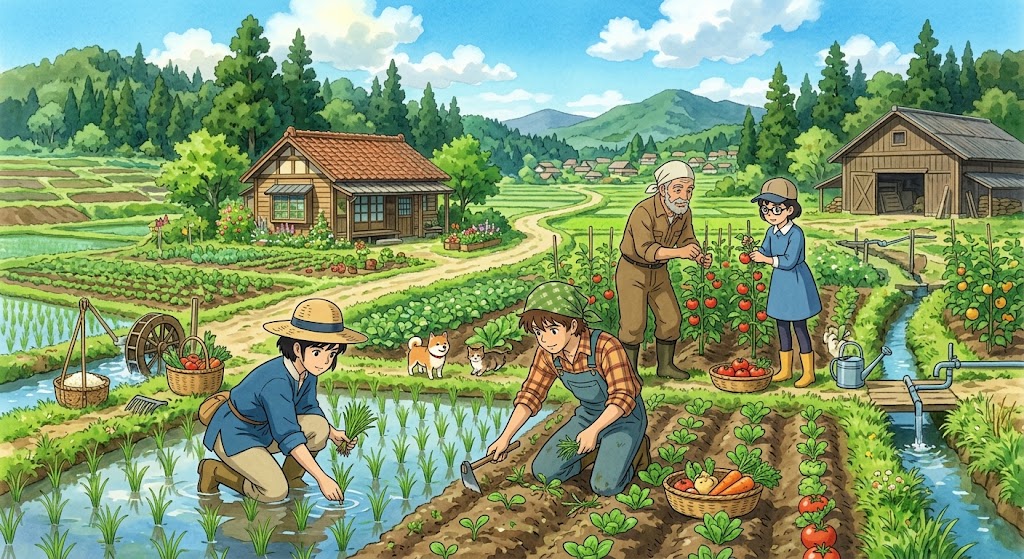
Successful farming depends on much more than planting seeds and waiting for harvest. Good crop production requires careful planning, suitable soil, proper irrigation, timely field operations, pest monitoring, efficient use of resources, and regular observation.
Whether a farm is small or large, better management can help farmers use land, water, labor, seeds, fertilizers, and equipment more efficiently. The goal is not always to produce more by simply adding more inputs. In many situations, productivity improves when existing resources are used at the right time and in the right amount.
A practical farming system should also be flexible. Weather conditions can change quickly, market prices can move unexpectedly, and crops may respond differently from one season to another. Farmers who keep useful records and adjust their practices based on actual field conditions can make better decisions over time.
Start With Proper Farm Planning
Good crop management begins before planting.
Farmers should decide which crops they want to grow, how much land will be used, when planting should take place, what inputs will be required, and where the harvested crop is likely to be sold.
A simple seasonal plan can include the expected planting period, seed requirements, irrigation needs, labor requirements, harvesting period, and expected storage or transportation arrangements.
Planning also helps prevent unnecessary purchases. Buying large quantities of inputs without estimating actual requirements can increase costs and create storage problems.
A farm plan should leave some room for unexpected weather and other changes. Agriculture is never completely predictable, so flexibility is an important part of good management.
Understand the Soil Before Planting
Soil is one of the most important resources on any farm.
Different crops perform better under different soil conditions. Soil texture, drainage, organic matter, pH, and nutrient availability can influence root development and crop growth.
A soil test can provide useful information about nutrient levels and pH. Instead of applying the same fertilizer program every season, farmers can use soil information to make more informed decisions.
Healthy soil also needs good structure. Excessive tillage, compaction, poor drainage, and loss of organic matter can gradually reduce soil quality.
Maintaining soil health is therefore not simply about adding fertilizer. It involves managing the entire growing environment around plant roots.
Select Crops and Varieties Carefully
Choosing the right crop is only part of the decision. Selecting a suitable variety can also influence production.
Farmers should consider local climate, growing season, water availability, soil conditions, disease pressure, market demand, and expected harvest timing.
A variety that performs well in one region may not perform equally well in another.
When trying a new variety, starting with a smaller area can be a practical way to evaluate performance before committing the entire farm.
Farmers can compare growth, maturity time, resistance to common problems, yield, quality, and market acceptance.
Use Quality Seeds and Planting Material
The quality of planting material can affect the entire crop cycle.
Poor-quality seeds may produce weak or uneven stands, making later field management more difficult. Healthy seedlings and appropriate planting material can provide more uniform crop establishment.
Farmers should obtain seeds and planting material from reliable sources and store them under suitable conditions.
Seed labels, variety names, planting dates, and other important information should be recorded so that performance can be evaluated later.
Follow Appropriate Plant Spacing
Plant spacing affects how crops use sunlight, water, nutrients, and available space.
Plants placed too close together may compete with one another and can experience reduced airflow. Excessively wide spacing can leave unused areas where weeds may develop.
The ideal spacing depends on the crop and variety.
Following recommended spacing guidelines and adjusting them only when there is a clear reason can help farmers establish a more uniform crop.
Good spacing also makes field inspection, irrigation, weed control, and harvesting easier.
Manage Water Efficiently
Water management is one of the most important parts of crop productivity.
Both under-irrigation and over-irrigation can create problems. Too little water can restrict plant growth, while excessive watering may contribute to nutrient loss, poor root conditions, and certain plant diseases.
Farmers should consider soil moisture, crop growth stage, weather, rainfall, and irrigation-system efficiency when deciding when to water.
Drip irrigation, sprinklers, furrow systems, and other methods can be useful depending on the crop and farm.
Water should be delivered where it can be used effectively rather than simply applying more water.
Protect Soil Moisture
Reducing unnecessary moisture loss can improve water efficiency.
Mulching is one practical method. Organic materials such as suitable crop residues, straw, or other plant materials can cover exposed soil and reduce evaporation.
Cover crops can also protect soil between major production cycles.
Maintaining soil organic matter can improve the soil’s ability to hold and release water, although the effect depends on soil type and management practices.
These techniques can be particularly useful in areas where water availability is limited.
Manage Fertilizer Carefully
Fertilizers can provide important nutrients, but more fertilizer does not automatically mean better production.
Excessive or poorly timed applications can waste money and may contribute to nutrient losses.
A more practical approach is to consider soil-test information, crop requirements, expected yield, and nutrient availability.
Farmers should pay attention to major nutrients as well as other nutrients when deficiencies are suspected.
Fertilizer should also be applied using appropriate methods and timing. Splitting applications for certain crops can sometimes improve nutrient availability during important growth stages.
Control Weeds Early
Weeds compete with crops for water, nutrients, sunlight, and space.
Young weeds are generally easier to manage than large, established weeds. Regular field inspection can therefore prevent a small weed problem from becoming a major one.
Farmers can combine several methods depending on their farming system. These may include cultivation, mulching, hand removal, crop rotation, cover crops, and other suitable management practices.
The objective should be timely management rather than waiting until weeds have already become difficult to control.
Monitor Crops for Pests and Diseases
Regular crop scouting is one of the most valuable management activities on a farm.
Farmers should inspect leaves, stems, flowers, fruits, and roots where appropriate. Changes in leaf color, holes, unusual spots, wilting, distorted growth, or insect activity can provide early clues.
Correct identification is important because different problems require different responses.
Not every insect is harmful, and not every damaged leaf requires treatment. Farmers should consider the size of the affected area, the stage of crop growth, and the potential impact on production before choosing a control method.
Early detection often provides more management options.
Encourage Useful Farm Biodiversity
A farm ecosystem contains many organisms, including insects, microorganisms, birds, and other wildlife.
Some organisms can support agriculture by pollinating plants or feeding on pest species.
Maintaining suitable habitat and avoiding unnecessary disturbance can support useful biodiversity.
Flowering plants, field margins, diverse cropping systems, and appropriate habitat areas can contribute to a more balanced agricultural environment when properly managed.
Biodiversity should complement crop management rather than interfere with production or farm safety.
Use Crop Rotation
Growing the same crop repeatedly in the same location can contribute to certain pest, disease, weed, and soil-management challenges.
Crop rotation changes the crops grown over time.
A rotation can include crops with different nutrient requirements and different root structures. It can also help break some pest and disease cycles.
Farmers should design rotations around their specific crops, climate, soil conditions, available markets, and equipment.
A well-designed rotation can become one of the foundations of long-term farm management.
Use Farm Equipment Efficiently
Machinery can save significant amounts of time and labor, but poor equipment management can increase costs.
Farmers should maintain tractors, irrigation equipment, sprayers, harvesters, and other machinery according to manufacturer recommendations.
Routine inspection can help identify problems before they result in expensive breakdowns during critical field operations.
Farm equipment should also be selected according to actual farm requirements. Buying machinery that is much larger or more complex than necessary can create unnecessary financial pressure.
For smaller farms, equipment sharing, custom services, or machinery rental may sometimes be worth considering.
Keep Detailed Farm Records
Record keeping is one of the simplest ways to improve farm management.
A farmer can record planting dates, seed varieties, fertilizer applications, irrigation events, pest observations, weather conditions, harvest quantities, labor costs, and sales.
These records create a history of what happened during each growing season.
Over time, the information can reveal useful patterns.
For example, a farmer may discover that one variety consistently performs better in a particular field or that a certain planting period produces more reliable results.
Good records turn everyday farming experience into information that can support future decisions.
Reduce Post-Harvest Losses
Crop productivity is not determined only by what happens before harvest.
A farmer can produce an excellent crop and still lose significant value through poor harvesting, handling, storage, packaging, or transportation.
Harvest timing should be appropriate for the crop and intended market.
Produce should be handled carefully to reduce bruising and physical damage. Storage conditions should also match the requirements of the crop.
Where possible, farmers should plan the movement of harvested products before harvesting begins.
Knowing where the crop will go can reduce unnecessary delays and improve product quality.
Improve Labor Management
Labor is another major farm resource.
Work should be planned around critical agricultural operations. Planting, irrigation, weed management, pest monitoring, and harvesting often have time-sensitive requirements.
Clear schedules can help workers understand what needs to be done and when.
Training is also important. Workers should understand equipment safety, crop-handling procedures, and the correct methods for performing important field tasks.
Better organization can improve productivity without simply increasing the number of workers.
Use Technology Where It Provides Real Value
Modern technology can support farmers in many ways.
Weather applications can help monitor forecasts. Soil-moisture sensors can provide information about irrigation conditions. GPS systems can improve field mapping. Farm-management software can organize records.
Remote sensing and satellite imagery can also help identify differences in crop growth across larger fields.
However, technology should solve a real problem rather than be purchased simply because it is new.
A simple digital record may be more useful to a small farm than an expensive system that requires complicated maintenance.
Diversify Farm Production
Depending entirely on one crop can expose a farm to additional financial and production risks.
Diversification can involve multiple crops, livestock, nursery production, specialty products, or value-added activities.
The right combination depends on available resources and local demand.
Diversification should be planned carefully because managing too many unrelated activities can increase complexity.
The strongest combinations are often those that share land, equipment, labor, customers, or farm resources.
Build a Practical Harvest Strategy
Harvesting should be planned before the crop reaches maturity.
Farmers should know the expected harvest period, available labor, equipment requirements, storage capacity, packaging needs, and likely buyers.
Harvesting too early or too late can reduce product quality depending on the crop.
Weather should also be monitored around the expected harvest period so that farmers can make adjustments where possible.
A clear harvest plan can reduce last-minute pressure and help protect the value of the crop.
Calculate the Real Cost of Production
Yield alone does not tell the complete story of farm productivity.
A crop can produce a large harvest while still generating limited returns if production costs are too high.
Farmers should consider seed costs, fertilizer, irrigation, labor, fuel, machinery, repairs, packaging, transportation, land costs, and other relevant expenses.
Comparing total production costs with actual sales revenue can show which crops or activities are financially sustainable.
This information can help farmers decide what to continue, modify, or discontinue in future seasons.
Create a Seasonal Improvement Cycle
Good farm management is a continuous process.
After harvest, farmers should review the season and ask what worked well, what failed, and what could be improved.
Perhaps irrigation was inefficient. Maybe a variety matured too late. A pest appeared earlier than expected. Labor costs may have been higher than planned.
These observations should be recorded rather than forgotten.
The next season’s plan can then be adjusted based on actual experience.
Final Thoughts
Better crop management does not depend on one revolutionary technique. It usually comes from many small decisions being made correctly and consistently.
Healthy soil, suitable varieties, quality seeds, efficient irrigation, careful fertilizer use, timely weed management, regular pest monitoring, proper crop rotation, good records, and efficient harvesting can all contribute to stronger farm performance.
Technology can provide additional support, but practical observation remains extremely important.
The most productive farms are often those that understand their own conditions and continuously learn from previous seasons. By measuring costs, monitoring crops, managing resources carefully, and adjusting techniques when necessary, farmers can build a more efficient and sustainable production system.
Farming will always involve uncertainty, but good preparation and disciplined management can make that uncertainty easier to handle while helping farmers get more value from the land and resources they already have.