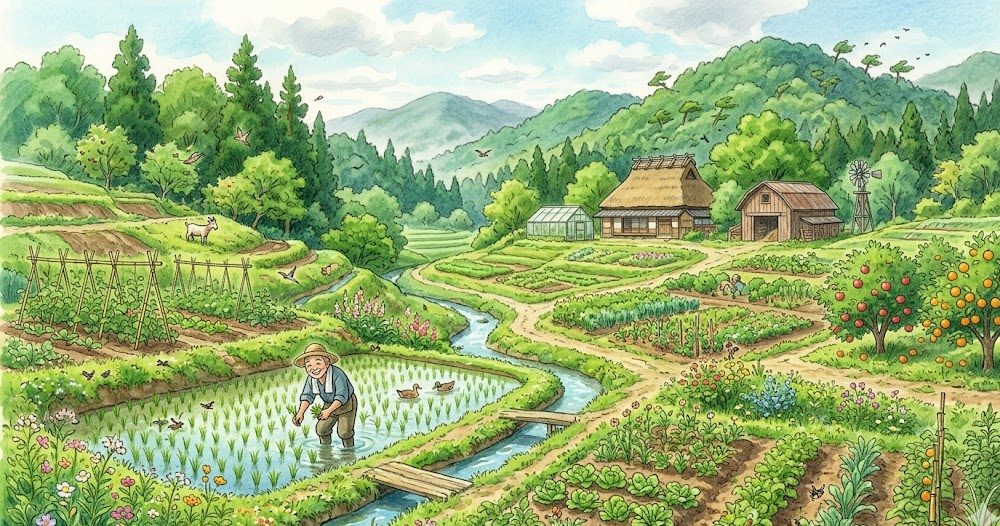
As the global population nears 8 billion and the impacts of climate change become more pronounced, the world is facing a critical crossroads in food production. For decades, “Chemical Farming” was hailed as the solution to hunger. However, the long-term consequences—soil degradation, water scarcity, and biodiversity loss—have forced us to look back at the wisdom of nature.
Natural Farming, often referred to as “Do-Nothing Farming” or “Regenerative Agriculture,” is emerging as the most sustainable, cost-effective, and environmentally friendly way to feed the planet. In this guide, we will explore the principles, benefits, and practical steps to transition to a natural farming ecosystem.
1. What is Natural Farming?
Natural Farming is an ecological farming approach that mimics the patterns of nature. Popularized by the Japanese farmer and philosopher Masanobu Fukuoka and further adapted in India as Zero Budget Natural Farming (ZBNF), this method eliminates the need for synthetic fertilizers, pesticides, and intensive tilling.
Unlike organic farming, which may still use external organic inputs like purchased compost, Natural Farming believes that the soil already has all the nutrients required for plant growth. The goal is to create a self-sustaining ecosystem where the soil, microbes, insects, and plants work together in harmony.
2. The Four Pillars of Natural Farming
To succeed in natural farming, one must adhere to four fundamental “No” principles that protect the integrity of the earth:
A. No Tilling (No Plowing)
In nature, the soil is never turned over. Earthworms, micro-organisms, and small animals do the work of aeration. When we plow the land, we destroy the soil structure and kill the beneficial microbes that provide nutrients to the plants. Natural farming leaves the soil undisturbed.
B. No Chemical Fertilizers
Plants do not grow because of chemicals; they grow because of a healthy soil-web. In natural farming, we use “Bio-stimulants” made from local resources (like cow dung and urine) to activate the soil’s microbial activity rather than feeding the plant directly.
C. No Chemical Pesticides
Nature has its own system of checks and balances. By encouraging biodiversity, we allow “predator insects” (like ladybugs) to eat the “pests.” If the soil is healthy, the plant develops a natural immunity to diseases.
D. No Weeding (In the Traditional Sense)
Weeds are not enemies; they are “Soil Healers.” They prevent soil erosion and add organic matter when they die. In natural farming, weeds are managed through mulching or by growing “cover crops” that compete with them naturally.
3. Core Techniques: The “ZBNF” Model
For those looking to implement this on a practical scale, the Zero Budget Natural Farming (ZBNF) model provides four essential tools:
- Jeevamrutha (The Life-Giver): A fermented microbial culture made from water, cow dung, cow urine, jaggery, and pulse flour. It acts as a catalyst to multiply the soil’s bacterial population.
- Bijamrutha (Seed Treatment): A natural coating for seeds to protect them from soil-borne diseases during the early stages of growth.
- Acchadana (Mulching): Covering the soil with crop residue or “live mulch” (creeping plants) to retain moisture, suppress weeds, and create humus.
- Whapasa (Moisture): Improving soil aeration so that the roots can breathe. This reduces water requirements by up to 90% compared to chemical farming.
4. The Benefits of Going Natural
A. Economic Freedom for Farmers
Traditional farming requires heavy investment in seeds, fertilizers, and power. Natural farming is “Zero Budget” because inputs are created on-site. This eliminates the cycle of debt for small-scale farmers.
B. Climate Resilience
Chemically treated soil becomes hard like concrete, leading to runoff during floods and cracking during droughts. Naturally farmed soil, rich in organic carbon, acts like a sponge. It absorbs excess water during heavy rains and retains moisture during dry spells.
C. Superior Nutritional Value
Studies show that crops grown naturally contain higher levels of antioxidants, minerals, and vitamins. There is no chemical residue (pesticides) in the food, leading to better long-term health for consumers.
D. Restoration of Biodiversity
A natural farm is a sanctuary for bees, butterflies, birds, and soil organisms. By removing toxins, we allow the local ecosystem to heal and flourish.
5. Challenges and How to Overcome Them
Transitioning to natural farming is not without its hurdles. The biggest challenge is the “Transition Period.” * Soil Healing Time: Soil that has been “addicted” to chemicals for years takes 2 to 3 years to regain its natural fertility. During this time, yields may slightly decrease.
- The Solution: Start small. Transition 10% of your land at a time. Use intensive mulching and inter-cropping (growing multiple crops together) to maintain income during the healing phase.
6. Natural Farming and the Digital Age
In 2026, technology is playing a surprising role in promoting natural farming.
- Smart Monitoring: Farmers are using low-cost sensors to monitor soil moisture (Whapasa) and microbial heat.
- Direct-to-Consumer Apps: Mobile platforms allow natural farmers to sell their “Chemical-Free” produce directly to health-conscious urban consumers at a premium price.
- AI Knowledge Bases: AI-driven tools help farmers identify local botanical extracts (like Neem or Ginger) to create natural pest repellents tailored to their specific region.
7. The Global Impact: Healing the Planet
Natural farming is more than just a technique; it is a solution to global warming. Healthy soil is the world’s second-largest carbon sink. By practicing natural farming, we are essentially “pulling” carbon out of the atmosphere and storing it in the ground. If practiced globally, this could offset a significant portion of industrial CO2 emissions.
Conclusion: A Call to Action
The era of “Mining the Soil” is coming to an end. The future belongs to those who “Nurture the Soil.” Natural Farming is not a step backward into the past; it is a sophisticated step forward into a future where technology and tradition coexist to protect the Earth.
Whether you are a commercial farmer looking to reduce costs, a home gardener wanting healthy vegetables, or an entrepreneur interested in sustainable agriculture, the principles of natural farming offer a roadmap to success.
Nature does not hurry, yet everything is accomplished. It is time we let nature do the farming.
Natural Farming Quick-Reference:
| Feature | Chemical Farming | Natural Farming |
| Input Cost | High (Purchased) | Zero (Home-made) |
| Water Usage | High (Flooding) | Low (Moisture/Whapasa) |
| Soil Health | Declining (Degradation) | Improving (Regeneration) |
| Yield Value | Standard Market Rate | Premium Health Rate |
| Environment | Polluting | Carbon-Sequestering |