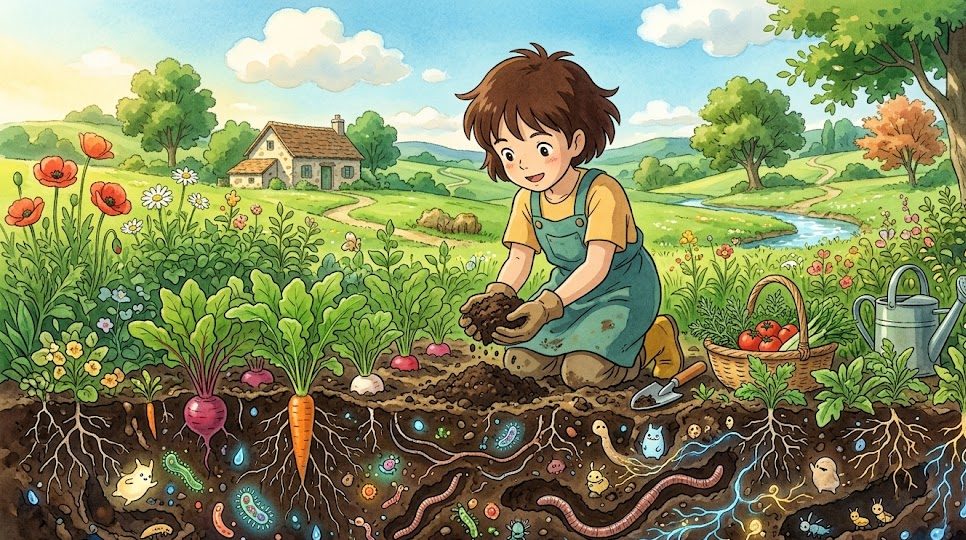
Most farmers look at their land and see a “medium” for growing crops. They see dirt—a passive, physical foundation that needs to be propped up with synthetic fertilizers and turned over with heavy machinery. This perspective is the single greatest barrier to high-profit, high-yield agriculture.
The truth is, your soil is not a passive medium; it is a living, breathing, highly active industrial complex. Beneath your feet, there is a sprawling metropolis of bacteria, fungi, protozoa, and earthworms, all working 24/7 to build the fertility of your land.
If you want to unlock the “hidden” productive power of your farm, you need to stop acting like a factory manager and start acting like a soil ecologist. Here is how to wake up your soil and put it to work for you.
1. Understanding the “Soil Food Web”
In industrial farming, we focus on NPK (Nitrogen, Phosphorus, Potassium) as if they are the only things that matter. But in a natural system, these nutrients are already present in the mineral particles of your soil. The problem is that they are “locked.”
The Soil Food Web is the biological key that unlocks these nutrients.
- The Bacteria & Fungi are the miners. They secrete acids that break down rock particles and organic matter, releasing trapped nutrients.
- The Protozoa & Nematodes are the gatekeepers. They eat the bacteria and fungi, and in the process, they release the nutrients in a form that plant roots can immediately absorb.
The Lesson: If you kill the soil life with harsh chemicals, you break the cycle. You are essentially turning your farm into a “hydroponic system” where the plant is dependent on you providing a constant drip-feed of fertilizer. To unlock your soil’s power, you must protect the biology.
2. The Power of “Organic Armor”
Healthy soil is never left naked. In nature, you will never find a patch of bare, exposed dirt unless there has been a disaster.
- The Hack: Use Mulching and Cover Cropping. By covering your soil with crop residues, straw, or green manure, you do three things:
- Temperature Control: Soil life is sensitive. A sun-scorched field can reach temperatures that kill beneficial bacteria. Mulch keeps the “metropolis” cool and active.
- Moisture Retention: A layer of organic matter acts like a sponge, holding onto rain long after it stops falling.
- Food Supply: As the mulch slowly decomposes, it provides a steady, diverse diet for the worms and fungi that are building your soil structure.
3. Ending the “Tillage Trap”
Tilling (plowing) is the “bulldozer” of the soil world. While it helps loosen the ground for planting, it is catastrophic for the soil structure.
Every time you till, you destroy the fungal networks (mycorrhizae) that act like a pipeline for water and nutrients to reach your plants. You also expose organic matter to the sun, causing it to oxidize and vanish into the air as carbon dioxide.
- The Strategy: Move toward No-Till or Reduced-Tillage practices. Use direct drilling or specialized manual tools to plant your seeds. When you stop disturbing the soil, the fungi create “glomalin”—a biological glue that creates perfect soil aggregates. This gives your soil that “crumbly” texture that allows roots to travel deep, accessing water and minerals that a tilled field could never reach.
4. The “Liquid Gold” Technique: Bio-Inoculation
If your soil has been degraded by years of chemical use, the “metropolis” of microbes might be dormant or depleted. You don’t need to buy expensive, lab-grown microbial boosters; you can grow your own.
Using a mixture of fermented cow manure, jaggery, and a handful of local forest soil, you can brew a microbial tea. The forest soil is the “seed” that contains the diverse, robust local microbes that have evolved in your specific climate. By multiplying them in a compost tea and applying them to your land, you are essentially “re-colonizing” your soil with its natural workforce.
5. Reading Your Soil’s Signals
Your soil is constantly telling you what it needs. You just have to learn the language.
- Compaction: If you see water pooling, your soil is “suffocated.” It needs deep-rooted crops (like daikon radish or legumes) to drill channels into the subsoil.
- Weeds: Certain weeds thrive in specific conditions. For example, some weeds love highly compacted, anaerobic soil, while others indicate a lack of calcium. Stop viewing them as enemies; view them as diagnostic tools. If you fix the deficiency that the weed is signaling, the weed will naturally lose its competitive advantage and disappear.
6. The Long-Term ROI: Building “Soil Carbon”
The most productive power of your soil is its ability to hold Carbon. Carbon is the “battery” of your soil—it holds water, stores energy, and creates the structure that allows plants to thrive even during droughts.
When you use organic amendments, avoid chemicals, and keep the soil covered, you are building Soil Organic Matter (SOM). Increasing your SOM by even 1% can allow your soil to hold thousands of gallons more water per acre. This is your insurance against climate change and the best way to ensure your farm remains productive for generations.
Conclusion: The Farmer as a Steward
Unlocking the hidden power of your soil is not a “quick fix” that happens in a week. It is a transition. It requires patience as you allow the soil biology to rebuild.
However, the rewards are immense. You will find that you need less fertilizer, less water, and fewer pesticides. Your plants will be healthier, more disease-resistant, and—most importantly—your profit margins will grow because you are no longer paying to fight against your own land.
Start today. Go out to your field, dig a small hole, and look at the soil. Does it smell sweet and earthy? Is it dark and crumbly? Does it have earthworms? If not, start the journey of healing. Feed the microbes, protect the surface, and let the soil do the heavy lifting for you.